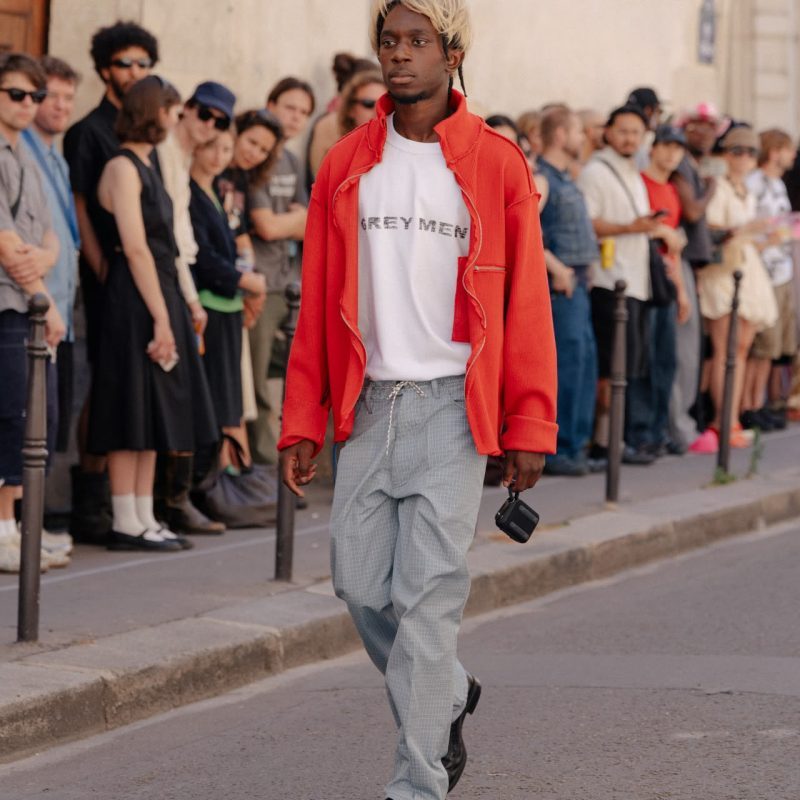
Behind every successful fashion brand is a less visible challenge: turning creative momentum into a financially healthy and sustainable business. During AFW26, Mario Ortelli, Managing Partner at Ortelli&Co, and Bas Stork, Founder of Grey Men, will explore this very question in their talk Built to Last: The Real Cost of Building a Fashion Brand. Ahead of the conversation, we speak to the two about the financial realities of building an emerging fashion brand, from funding and distribution to sustainable growth and the support needed to turn creative potential into a lasting business.
Mario Ortelli’s perspective comes from decades of working at the intersection of business and luxury. As Managing Partner of Ortelli&Co., he advises companies in the luxury goods industry on strategy, digital, M&A and operations. His previous experience includes leading Bernstein’s global luxury goods sector and 15 years at The Boston Consulting Group and Value Partners, where he worked with luxury and premium consumer businesses on international projects.
You have spent much of your career advising luxury and fashion businesses. What first drew you to the business side of fashion?
Mario: I was born and raised in Milan, and I was exposed to the fashion houses from a very young age, as many family friends worked in the industry. It was simply part of the fabric of the city I grew up in. What started as familiarity became genuine interest, and then a passion, because fashion and luxury sit at a rare intersection: creativity, storytelling — what we used to just call marketing — heritage, and a real, growing global business, all at once. I always had more of a business sense than a creative one, so it felt natural to find my place on the business side of the industry rather than the creative side.
Bas: As a child, I was influenced by my mother, who loved fashion, especially high-fashion labels Fendi and Jil Sander. I often went shopping with her and read her fashion magazines. After my time at EY Tax Consultants’ Entertainment Group in Amsterdam, I founded the creative business management firm Grey Men and soon started working with emerging high-fashion labels from the Netherlands.
When we talk about the success of a fashion brand, we often focus on creativity, visibility and cultural relevance. What tends to be overlooked when it comes to building a successful business?
Mario: We talk a lot about creativity, visibility and cultural relevance, and rightly so, but the thing that gets overlooked is consistency. Building a successful fashion business means protecting a sharp, legible brand image and producing products with a real identity, season after season, year after year. Cultural relevance can spike overnight; a business is built by holding that identity steady over time.
Bas: Apart from creativity, visibility and cultural relevance, which are of course the most relevant aspects, the intense economic realities of high fashion mean that fashion designers and labels are very much and structurally challenged in the area they often dislike the most, because it tends to interfere with the creative side: the business model of high fashion. More than in other creative industries, the financial challenges are significant and can last for a long time.
What are some of the biggest financial or strategic challenges facing emerging high-end fashion brands today?
Mario: The biggest challenge facing emerging high-end fashion brands today is distribution. Wholesale is in structural crisis and retailers are far less willing to commit to the inventory and assortment risk that used to underpin the whole system, so that route to market is narrower than it used to be for a young brand. At the same time, building a direct-to-consumer channel that is genuinely visible, both offline and online, has become extremely costly. Brands are being squeezed between a shrinking wholesale opportunity and an increasingly expensive direct one.
Bas: Apart from the global situation Mario describes, specifically in the Netherlands, the biggest challenge is funding the development from a promising start as a designer towards becoming an emerging fashion brand on its path to international recognition. This is also related to achieving a minimum turnover to be internationally relevant, moving in line with the international fashion calendar, showing collections on an international stage, and doing business with agents and distributors. For a certain period of time, the better it goes, the more funding is needed.
The title of your AFW talk is Built to Last. What does it actually take for a fashion brand to last?
Mario: Fashion is not a sprint, it’s a marathon. What it actually takes for a brand to last is discipline about pace: a house has to measure and control the speed of its own growth rather than chase every opportunity put in front of it, and it has to be consistent in product, in image, in distribution, in every decision, because consistency compounds over decades in a way that one great season never will.
There is increasing discussion around new forms of structural support for fashion, including the possibility of a fashion fund. What could this kind of support realistically change?
Mario: For a subscale brand, access to a fund, or better, a council built around that fund that provides not just capital but access to expertise, distributors and real commercial opportunities, would be crucial. Just as important is mentoring in the areas that sit outside a founder’s core skill. If a founder is a talented designer, they cannot also be expected to be a superhero across finance, marketing and supply chain. Structural support that fills those gaps is what actually lets creative talent survive long enough to build a business.
Bas: Exactly. This is the problem in the Netherlands. There is no serious local fashion business landscape, and we have no high-fashion or luxury groups here. Dutch fashion labels have to survive by working autonomously with private investors, often without sufficient knowledge of the business and sometimes with dominant intentions. At the same time, Dutch labels often do not have the financial capacity to pay for high-end guidance from financial controllers, business managers and (tax) lawyers. A Dutch fashion fund would mean a lot in the right direction. We are working on it at Grey Men.
How important is Amsterdam and the Dutch fashion ecosystem in creating the conditions for emerging brands to grow internationally?
Mario: What makes Amsterdam and the wider Dutch ecosystem well positioned for that is its cultural dynamism: a genuinely diverse, cross-pollinating scene in music, art and design, sitting on top of a solid academic backbone in fashion and art education. That combination is what attracts talent in the first place and, more importantly, gives them a reason to stay and build here rather than leave the moment they are ready to scale. And there is a real commercial opportunity in front of Dutch brands right now: blending that creativity and cultural relevance with a genuine sustainability DNA and a pragmatic, almost Nordic, product sensibility positions them well for the accessible luxury segment, precisely at a moment when several established international luxury brands have gone ballistic on pricing and left real space open just below them.
Bas: We just have a lot of great talent and still have the right climate for creativity, great possibilities for creative and fashion education, etc. Moreover, the Dutch contemporary music scene is doing great, and this intertwines with fashion.
Having worked with brands at different stages of their development, what is one piece of advice you would give to a designer who wants to build a brand that is still here in 10 or 20 years?
Mario: My honest answer is that the ambition should not be to last 10 or 20 years; it should be to last forever. And to get anywhere close to that, a brand has to pace its own growth, as I said, because fashion is a marathon, and it has to stay consistent with what it actually stands for. The brands that disappear are usually the ones that grew faster than their identity could support, or that changed what they stood for to chase a moment.
Bas: MIC DROP. Let’s take Amsterdam’s offline (street) fashion label AICHE as an inspiring example.
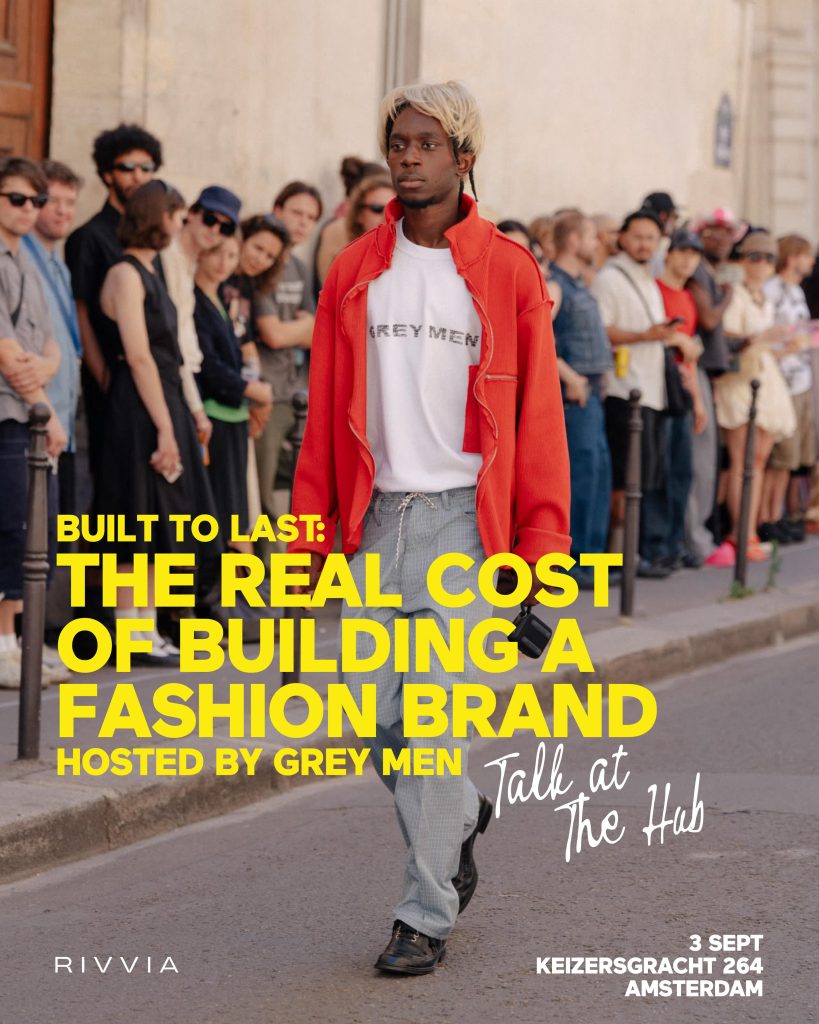
Built to Last: The Real Cost of Building a Fashion Brand
Join Grey Men at The HUB at RIVVIA during Amsterdam Fashion Week for Built to Last: The Real Cost of Building a Fashion Brand, a panel exploring the economic realities of building an emerging high-end fashion brand — from funding and distribution to long-term growth and structural support.
3 September 2026
2 PM – 3 PM
The HUB at RIVVIA, Keizersgracht 264, Amsterdam
Sign up here
The conversation will feature Bas Stork, Max Zara Sterck, Milki Abadura, Danial Aitouganov and Bregje Lampe, moderated by Mario Ortelli. The talk is hosted by Grey Men.