A decade into her career and ten years on from her Amsterdam Fashion Week debut, Tess van Zalinge has evolved far beyond the role of fashion designer alone. Through couture, research, curation and collaboration, she has built a practice rooted in craftsmanship, transparency and emotional connection. As she celebrates her label with a major anniversary year, van Zalinge reflects on growth, independence and the future of her world.
You debuted your label on the official programme of Amsterdam Fashion Week in 2016. How did that come about?
It really started during my time at the Amsterdam Fashion Institute. It was hardcore. I was working non-stop, no breaks and no holidays, but I was also given every opportunity to develop myself as a designer. I took part in Lichting and showed my graduation collection in London. I paid a price for that period, but I also got a lot in return. After graduating, I freelanced in the industry for four years, working across everything from couture to ready-to-wear, yoga wear, bags, really everything. But I missed designing for myself. I was working from my atelier in Utrecht and slowly started creating again from a more personal, emotional place. At the same time, I stayed in touch with my mentors from AMFI and people I had met while freelancing. I would casually mention that I had started designing for myself again. The fashion world is very small, so at some point that reached the former Creative Director of Amsterdam Fashion Week. Because I had done Lichting, I was already somewhat on their radar. Three months before Fashion Week, she contacted me and asked if I wanted to present what I had been working on.
Looking back, how did that first AFW show shape the trajectory of your label?
When they asked me, I thought: oh my god, I hadn’t even considered this yet. I only had a few sketches and toiles, very early ideas. So with just one intern, I made the entire collection. At that point, I didn’t even have an email address, Instagram or a website. I hadn’t thought about positioning or strategy. I only knew that what I was making would be shown at Fashion Week. Then everything changed very quickly. The collection won an award, I moved to Amsterdam, opened an atelier, and within a year I showed multiple times at AFW, ending with my biggest show, Royal Delft. That first year was intense. People came to my show and couldn’t even find me online. I was a complete unknown, and suddenly everyone wanted something from me.
I realised very quickly that the pace of the industry didn’t align with how I wanted to work. I’ve always been focused on sustainability, not just in materials, but in how the industry functions as a whole. So I stepped back. I decided to stop showing at Fashion Week for a while, choose my own path, and stop producing multiple collections a year. I needed that time to understand the system and realise that I didn’t agree with it. Since then, I’ve been building my practice much more consciously, shaping how I want to work and navigate this industry. At the time, I was about twenty-five. I thought: I’ll just make a collection, and if it doesn’t work, I’ll go back to freelancing. That freedom, having nothing to lose, was actually very important.
You have since shown internationally and returned to both Copenhagen and Amsterdam Fashion Week. What brought you back?
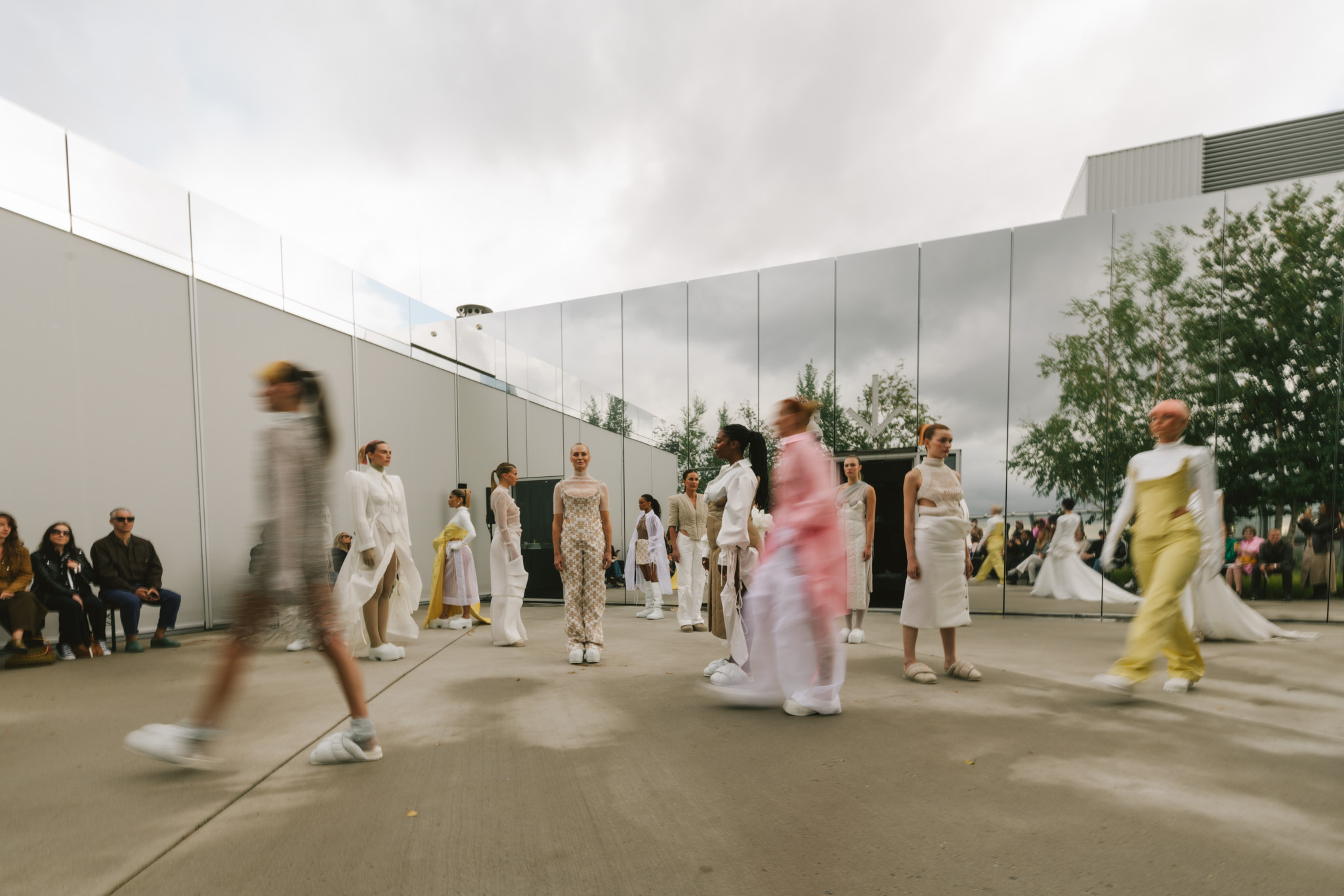
In the years after, I showed in very different contexts: Helsinki Fashion Week, Milan Design Week, museums, art weeks. I realised my work sits as much within art as it does within fashion. My biggest dream had always been Copenhagen Fashion Week because of its aesthetic, its people, its approach to sustainability. In 2023, I was invited to present my work there. At the same time, Danie Bles called to ask if I wanted to open Amsterdam Fashion Week. Copenhagen happened just before Amsterdam, so we decided to show the same collection in both places, but in slightly different ways. I chose to open Amsterdam Fashion Week on the rooftop of the Boijmans Depot, the first designer to do so, which was incredible. In a way, that moment allowed me to realise both dreams: returning to AFW on my own terms, while also stepping into Copenhagen.
You often speak about creating a healthier fashion system. What does that mean to you in practice?
It means questioning everything. Not just the materials, but the entire structure. Sizing, casting, the teams you work with backstage, how you treat people in your atelier, working hours. In couture, it is still very normal to work through the night and to do unpaid labour. That should not be okay. I don’t even want to call it healthier. I just want it to be normal, because the current system is not. In the beginning, my focus was on the product: handmade pieces, sustainable materials. But over time, I realised you can only create a truly healthy system if you address every layer.
And yet you still operate within that system. How do you navigate that tension?
I think you have to be part of the system if you want to change it. If you place yourself outside of it, it becomes very difficult to have any impact. We only make one piece per design. I’m not interested in dressing as many people as possible. We create conversation pieces. Some are sold, some are acquired by museums. In 2020, we also introduced a rental system. You can buy a piece, but you can also rent it. A corset might cost €3,500 to buy, but you can rent it for €100. That price is the same for everyone, stylists, celebrities, it doesn’t matter. In the beginning, I experienced resistance. People expected exposure in exchange for wearing something. And I understand that, and I’m grateful, but my team still needs to be paid and the garment needs to be maintained. The fashion industry upholds many standards and practices I fundamentally do not agree with so I make sure I challenge all of it. Sometimes it works, sometimes it doesn’t, but I still feel like I’m building towards something that makes sense.
Your work often centres around people, not just as models, but as collaborators. How does that shape your process?
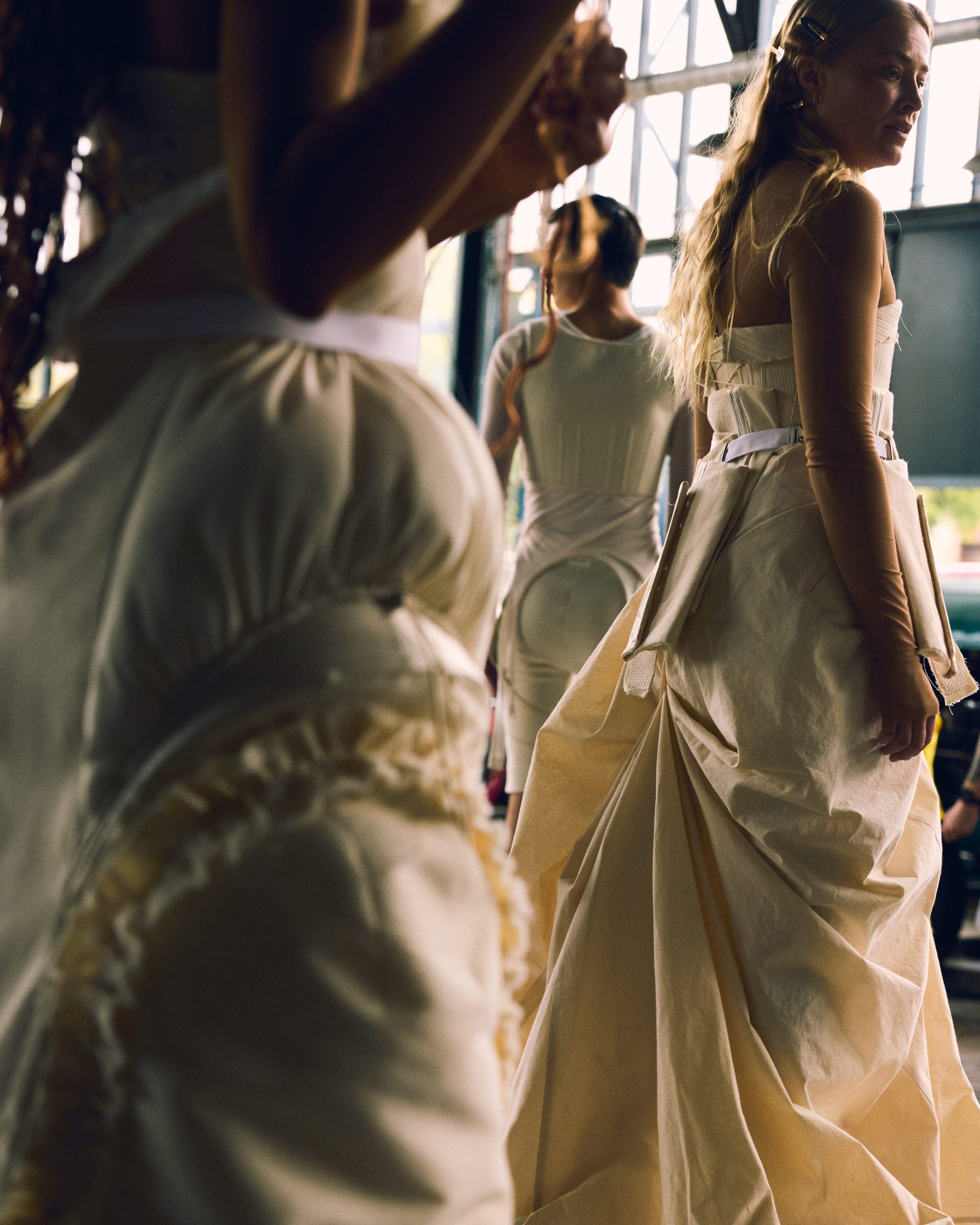
It’s very intuitive. When I’m casting, I look for personality. People I connect with, people I’d genuinely like to have a coffee with. Often they are people I’ve known for years, or people I’ve worked with who became friends. I don’t design with one specific person in mind from the beginning, but I do know who fits the world of the brand. Once the collection starts to take shape, I begin matching looks to people. It’s important to me that they feel empowered. In the past, I actually really didn’t enjoy my own shows. I would be backstage and feel uncomfortable, almost disconnected. All my work was already done, and I didn’t feel part of what was happening. It often left me with an empty feeling. At some point, I realised I only wanted to be surrounded by people I truly know. So I started casting the children of my pattern cutters, close friends, actual family. Since then, everything changed. Now it feels much more like a celebration. Of course there are still models, but often they’re people I’ve known for ten or fifteen years.
You’ve said you don’t see yourself solely as a fashion designer, but simply as a designer. What feels limiting about the label of fashion, and why is it important for you to work beyond it??
Because I enjoy it. I’m currently doing academic research with ArtEZ University of the Arts and State of Fashion, looking into the role of animals within fashion. That kind of research feeds back into my work. I’m also curating my own solo exhibition, and I didn’t necessarily have to take on the role of curator, but I did because I enjoy learning that too. I like seeing how I can use our creative minds together with my team. If there is one thing I don’t have, it is time, but I do find it super fun. I think that one collection a year and all the other things I do around it is also a way for me to show that you can make fashion without producing. As a maker, you don’t have to do just one thing anymore. If there is a clear message behind your creativity and how you give shape to it, then it can all simply coexist.
You were invited to curate part of Reflections on Fashion at Kunstmuseum Den Haag, opening in July. How did it feel to interpret fashion history through your own eyes?
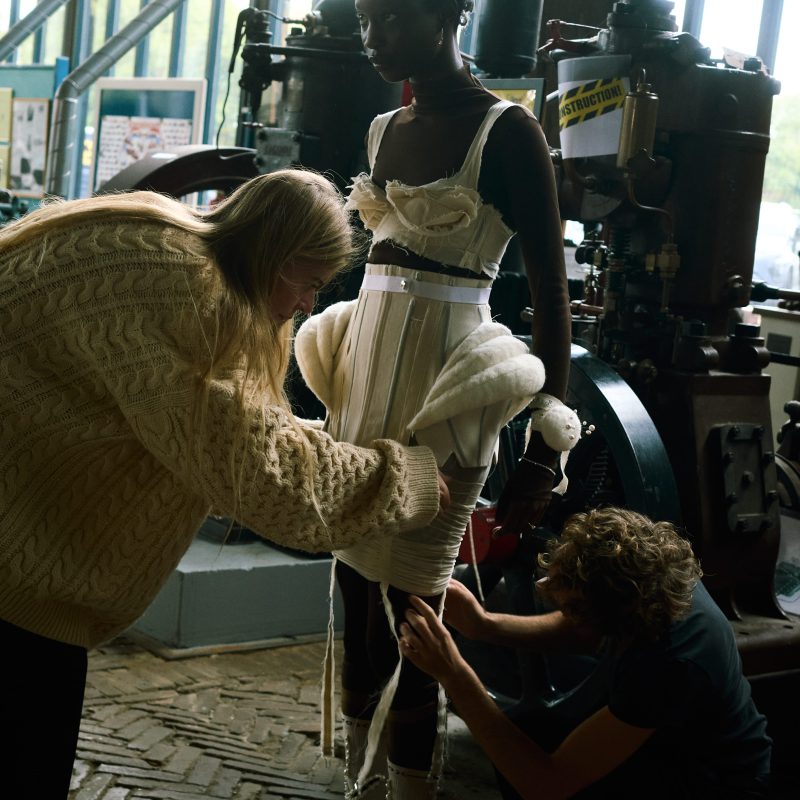
It started with the museum acquiring several pieces from my archive for my ten-year anniversary. From there, they invited me to curate part of the exhibition from my own perspective. I was allowed to raise a number of themes as the common thread of my research within the depot. As a nerd who always wants to keep learning, that is truly heaven. The best part is that I was given a stair cart, that they had prepared everything in terms of themes, and I was allowed to pull everything out of the depot and examine it. It was truly very special to be allowed to look around there and pull open drawers. I had a few subjects that recur very often in my work. Traditional Dutch regional costume, corsets, lingerie, embroidery and patchwork techniques, crinolines. I also find things that are broken or were repaired in the past very fascinating. I worked very intuitively, and was given the space to be so.
Your solo exhibition later this year feels like a full circle moment. How are you approaching it?
It really is. Centraal Museum was the first museum to acquire my work back in 2017. Realising that something I made would remain there forever was already very special to me. Being able to now present a solo exhibition there, in the city I’m from, truly feels full circle. An exhibition like this is often approached as a solo celebration of your oeuvre, but I’m not going to do that. I’ve involved all kinds of makers who inspire me. I like sharing my stage and I enjoy working with young designers. Collaborating with other people and different disciplines gives me a lot of energy. It doesn’t suit me to do things alone. Transparency is a key theme in my work, on every level. Not just visually, but also in how I work, who I work with, and how things are made. That will also be central to the exhibition.
If the first ten years were about building, what are the next ten about?
Last year, I made the first step towards my tenth anniversary collection, Toile Deluxe Keurslijf. I think the word keurslijf, which will also be the title of my exhibition, really captures how I feel within this industry. ‘Keurslijf’ stands for wanting to wiggle yourself in a garment that doesn’t fit quite perfectly yet, trying to create your own shape within it. I think that is forever my game within the industry. For the first 10 years, I was busy searching for my signature; that is more steady now, but I think it will be a forever push and pull. I also always have to keep doing new things; that is part of my personality too. How I see it is that the foundation has been laid, and now I am going to build a house on top of it.