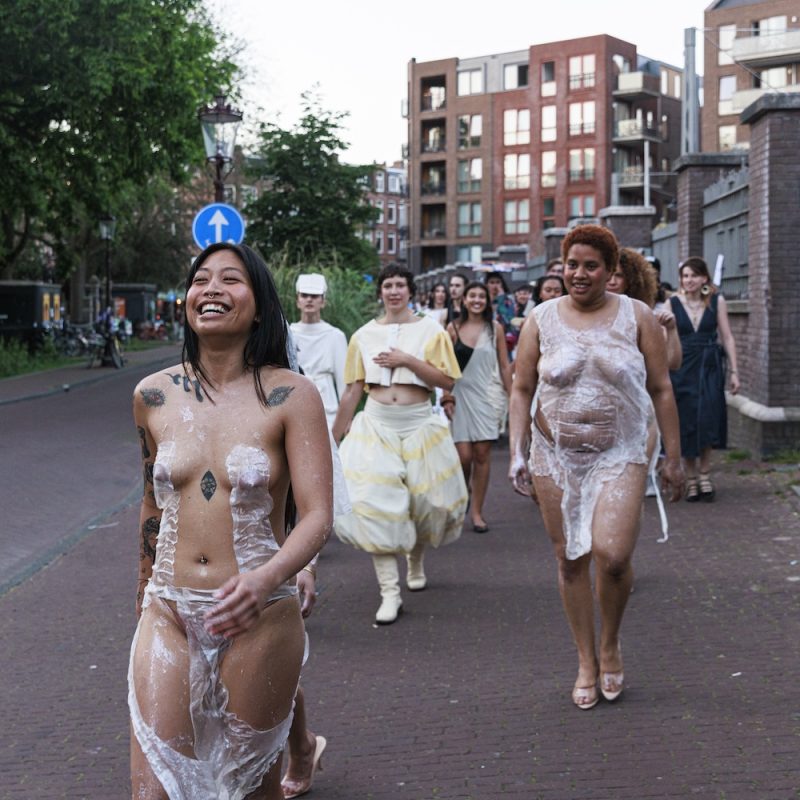
Presented in and around De Hallen Studio’s in Amsterdam, this year’s Gerrit Rietveld Academie graduation show extended beyond the venue through livestreams broadcast into neighbouring shops and eateries along Kinkerstraat, allowing passersby to catch fragments of the performances and collections unfolding inside. The concept of democratising the fashion show, particularly within the context of Rietveld, is a welcome one. The academy’s community is vast, with tickets often selling out quickly and venues continuously packed with friends, family, alumni, critics, scouts and supporters. Yet, while the initiative widened accessibility, the more interesting question remained somewhat untouched: what actually happens when this level of fashion “otherness” is exposed to everyday life? What are the reactions of people ordering fries or sitting down for a döner when confronted with the glittering near-naked bodies of Estefanía Escalona Millano’s collection or the overwhelming carnival cacophony of Feliz Aaliyah Sánchez Buitrago’s maximalist world?
Throughout the years, Gerrit Rietveld Academie has continuously emphasised that it is not a conventional fashion school, but rather an art school with a fashion department. The graduation shows rarely focus on fashion in the traditional sense of the word, nor on producing industry-ready designers in the way many other academies do. Instead, the presentations function as intersections of performance, installation, sound, choreography and clothing, where garments become one component within a larger artistic ecosystem. In recent years especially, the department has leaned heavily into its position as the “other” within Dutch fashion education, embracing experimentation, awkwardness and conceptual world-building over polish or wearability. This year’s concert-like setup, where visitors remained standing rather than observing from fixed seating, further reinforced that sentiment.
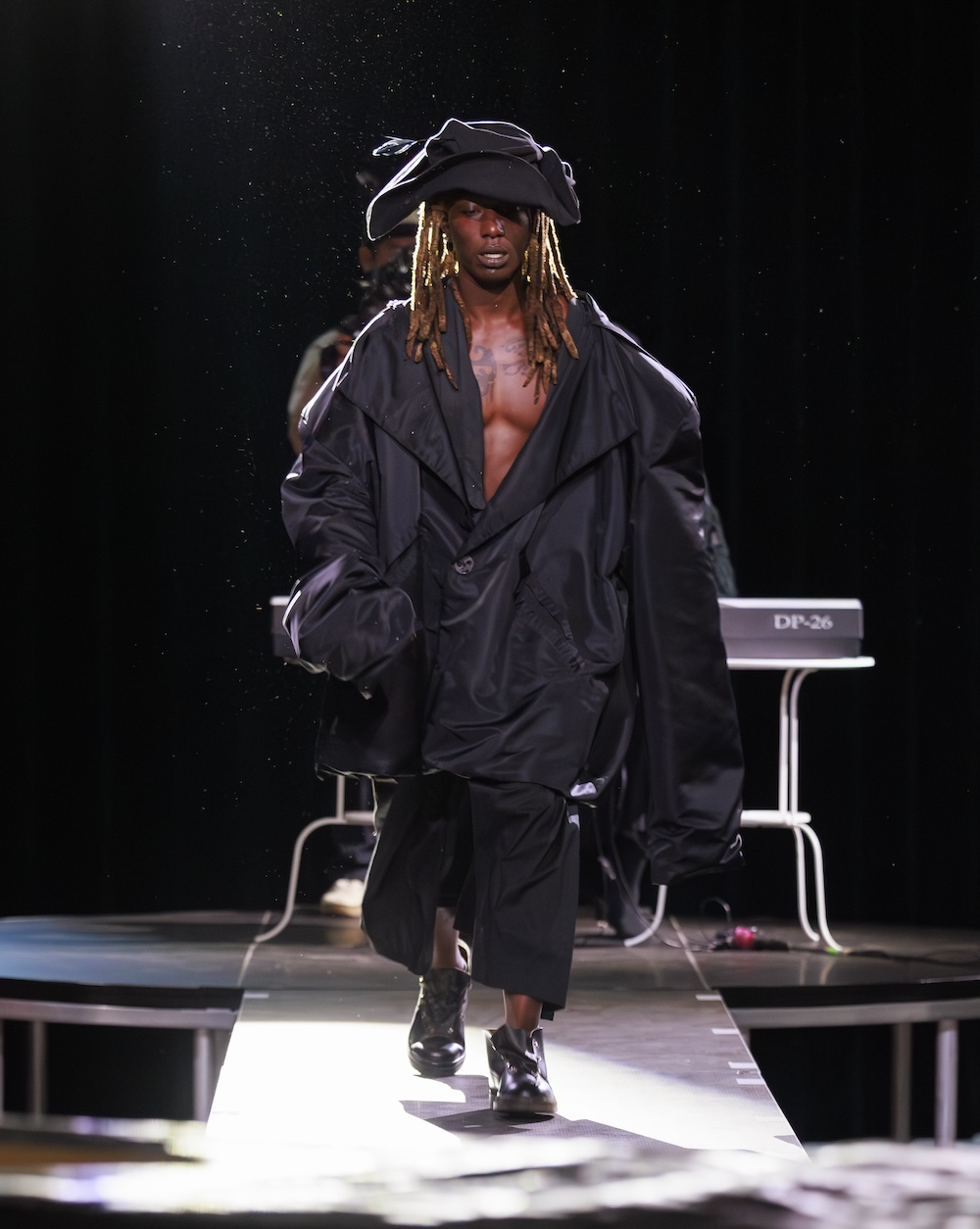
Centred on stage stood an intricately decorated black casket, surrounded by an all-black cast resembling a peculiar funeral procession of artistic misfits. Holding hands, skipping in circles and chanting over live instrumentation, the performance carried the atmosphere of a cult ritual somewhere between mourning ceremony and theatre production. Nikolaj Szwaja’s statement “I want to bury my childhood” reinforced the feeling that the collection functioned as a symbolic farewell to adolescence itself. Despite the heavy performative framing, the garments themselves managed to retain attention throughout, something not all designers during the evening succeeded in doing. The collection felt remarkably refined and cohesive. A violinist appeared with pinned-up rollers in her hair mirrored by the circular sculptural endings of a black blazer curling upwards around the hips. Elsewhere, heavy leather shoes stomped across the stage underneath a dramatic pirate-like hat and an oversized blazer featuring double lapels and a single button closure, arguably one of the strongest silhouettes of the evening. The collection approached couture territory in both execution and theatricality, culminating in a traditional “bride” look: a stiff elongated gown stretched over crinoline structures, transitioning into a contrasting fabric, complete with elevated shoulders and a bouquet of red roses.
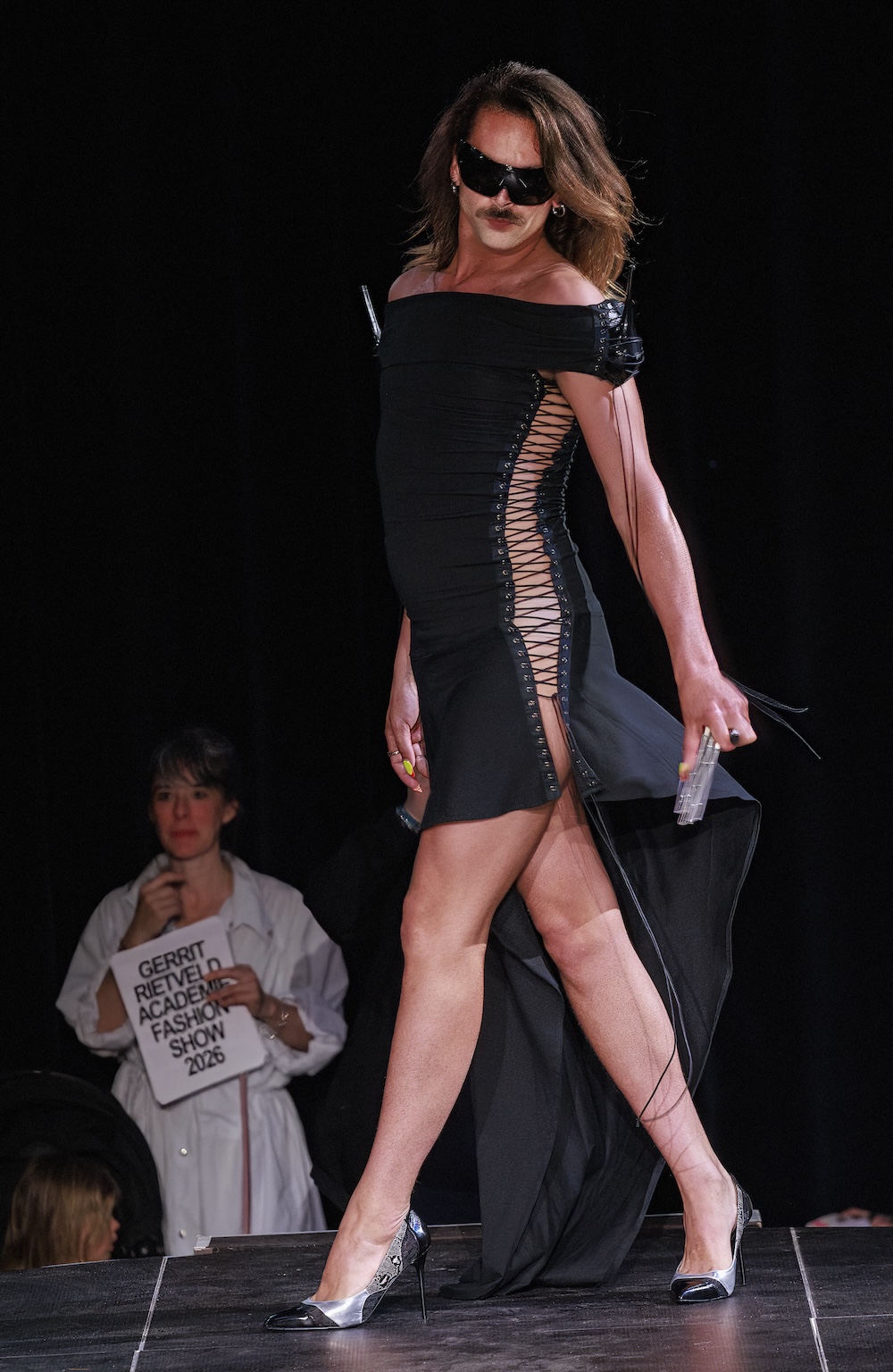
Joris Janssen (whom you might recognise from the notoriously beloved Patchwork Family gang) got DJ and Amsterdam icon Sammie aka Slimfit to walk down the runway carrying a stone dog deemed Waltur, adorned with a pink collar matching a baby pink shirt-bikini hybrid. Loud, chaotic and unapologetically camp, the performance unfolded somewhere between underground club night, queer protest and hypersexual fever dream. Central to the collection was Janssen’s reclaiming of “diva” aesthetics, transforming excess, controversy and hyperfemininity into tools for challenging heteronormative expectations. The accompanying manifesto asked: “Why say diva like it’s a bad thing?”, a sentiment that translated clearly throughout the presentation’s unapologetic silhouettes and deliberately absurd styling choices. The strongest look of the collection combined technical construction with theatrical absurdity: a white corset with exposed boning from which a pair of stilettos violently emerged at the hips, creating sharp protrusions that turned the body into something simultaneously glamorous and dangerous. Beneath it, tiny lace-up briefs extended into an exaggerated chapel train, pushing the collection’s fascination with camp spectacle and distorted sexuality to its furthest point.
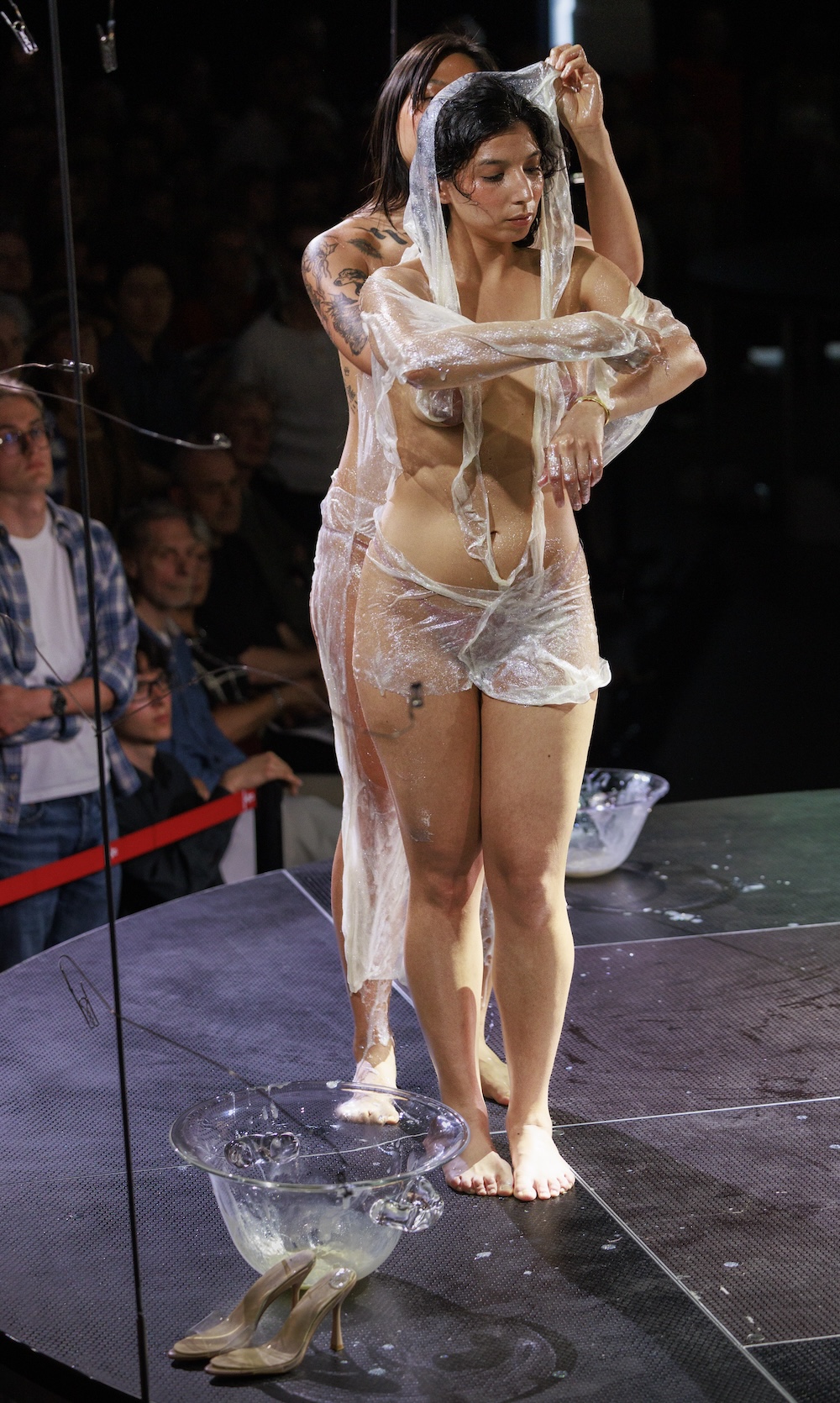
Estefanía Escalona Millano’s collection offered one of the evening’s most visually arresting performances, transforming the stage into a ritualistic landscape of sensual rebirth. Nearly naked performers stood surrounding bowls filled with soapy water, while translucent mesh-like materials hung suspended from metallic constructions across the space. Slowly, the performers removed the wet fabrics and began washing them by hand, before draping the glistening textiles over one another’s soaked bodies. The collection felt ephemeral in both materiality and presentation, less concerned with fixed silhouettes and more with transformation itself. Escalona Millano approached fashion almost as a sensorial ritual, allowing water, touch and movement to dictate the garments’ final form.
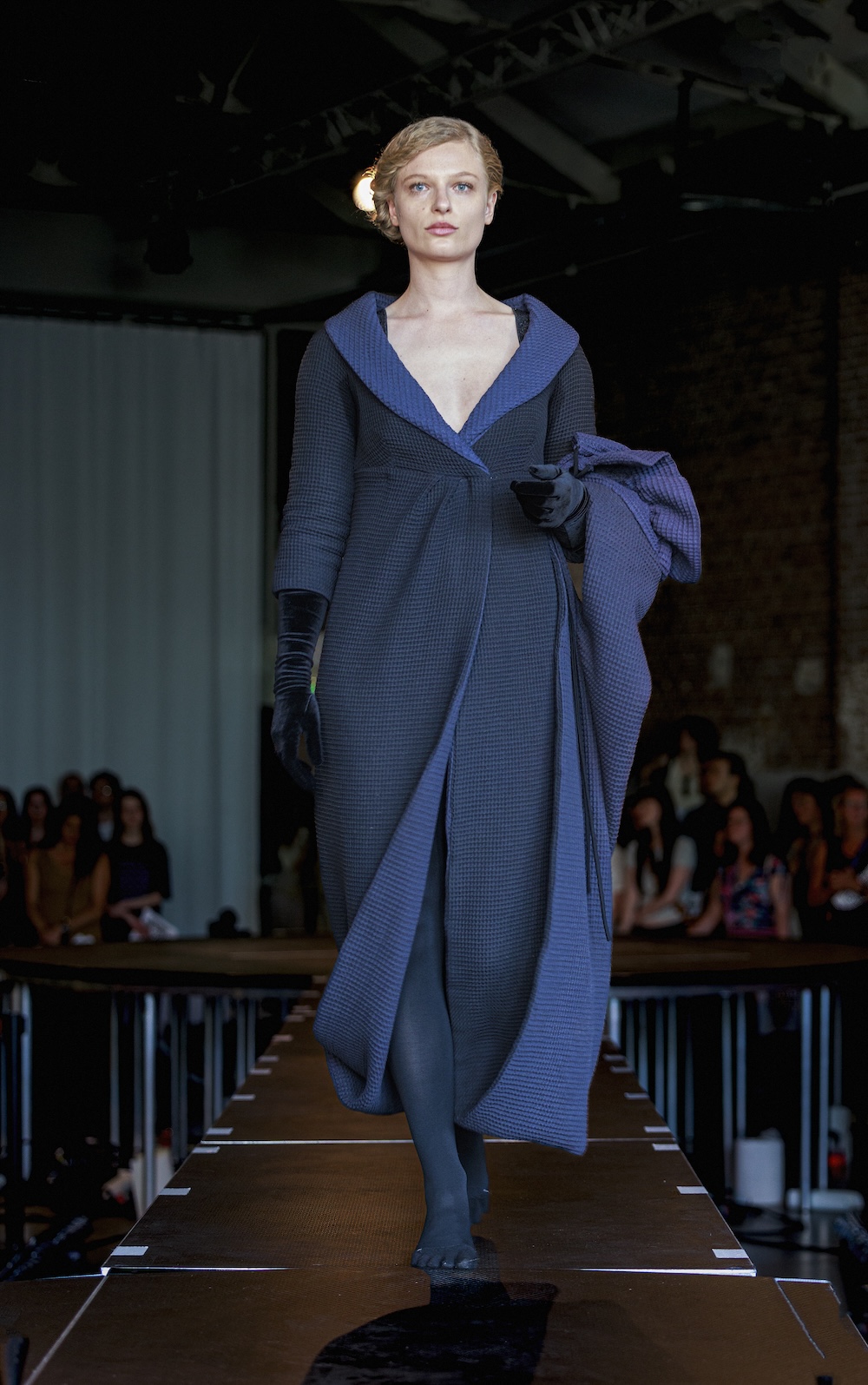
Working from her own experience with sensory overstimulation, Evelina Nanny Eliasson reconstructed uncomfortable secondhand garments into softer, more wearable forms, after realising her own wardrobe gravitated almost exclusively towards jerseys, soft compression and garments that “disappear against the skin”. A white shirt dip-dyed in black was paired with a crinkled leather-like windbreaker, while a heavily padded black skirt attached to a minimal white top appeared almost too weighty for the garment carrying it. Throughout the performance, barefoot models carefully tiptoed across the stage towards two pairs of shoes with wooden massage soles. Trying them on one by one, the models appeared to make walking itself into an act of negotiation between discomfort and relief. Ironically, despite originating from feelings of discomfort and hypersensitivity, Eliasson’s collection perhaps emerged as one of the evening’s most wearable.
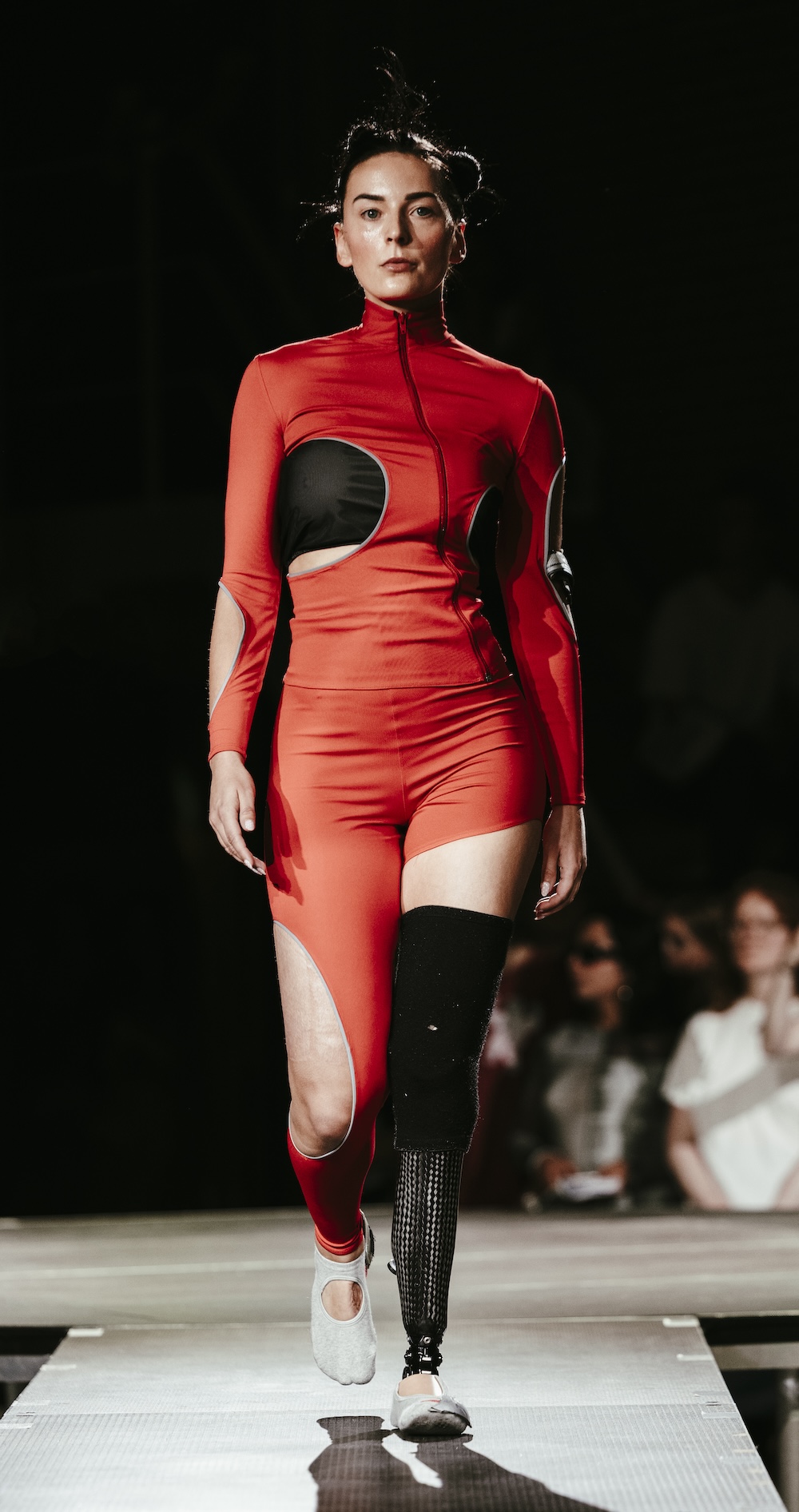
Simone Winder approached sportswear through a deliberately distorted lens, presenting a series of reconstructed performance garments that questioned the increasingly sexualised aesthetics of women’s gym clothing. Models moved across the space like a troupe of robotic athletes, illuminated by harsh flashlights that amplified the synthetic textures and sculptural asymmetries of the looks. One look in particular transformed a towel into a toga-like top gathered tightly between panels of Lycra, balancing somewhere between athletic functionality and improvised drapery. Through imbalance, humour and intentionally visible interventions, the collection attempted to reclaim bodily autonomy through disruption rather than idealisation. At times however, some of these deliberately unresolved constructions hovered closely to the visual language currently dominating experimental upcycling fashion, occasionally diluting the strength of the collection’s otherwise sharp conceptual foundation.
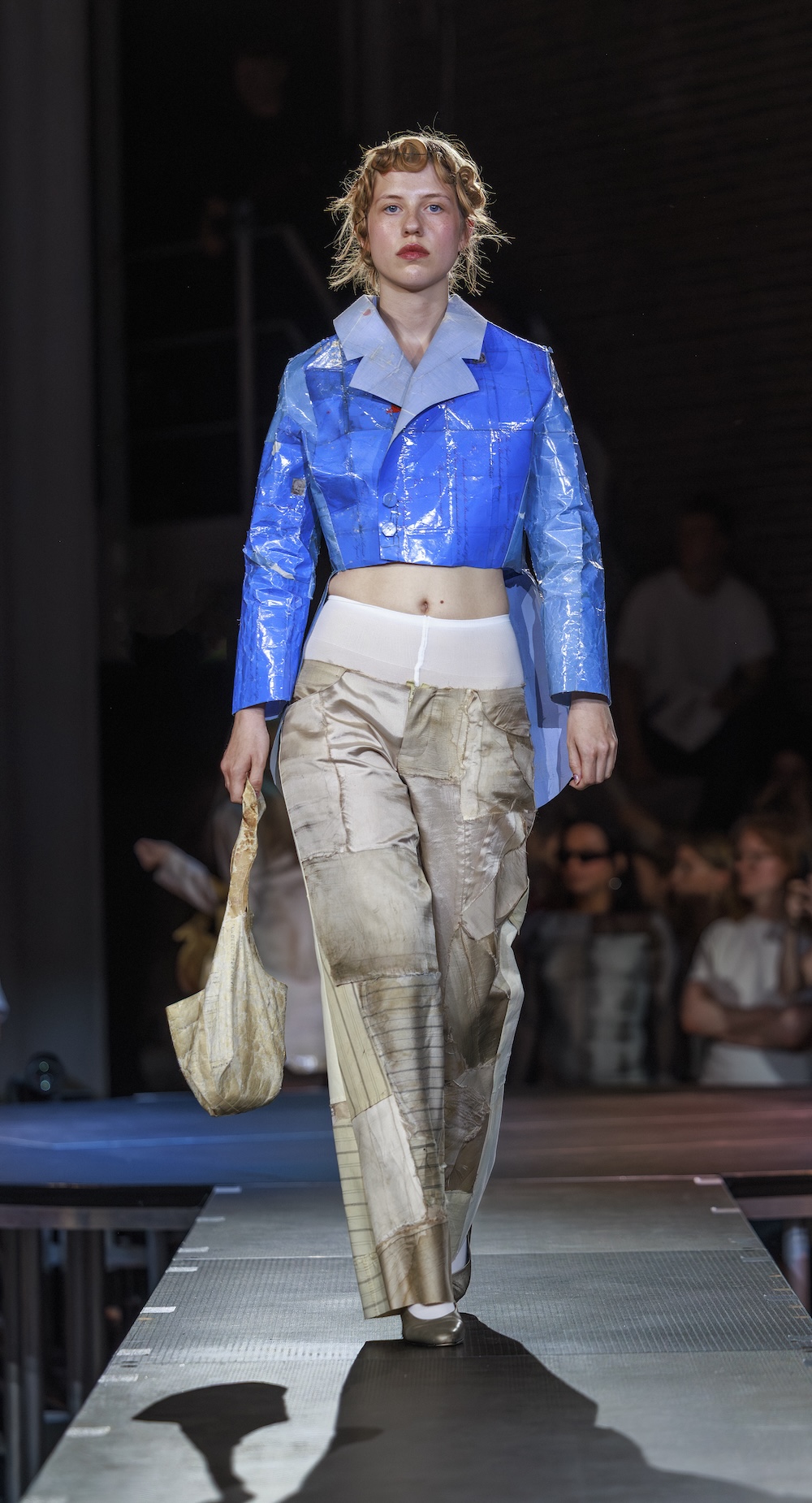
Johanne Fage-Larsen’s collection centred around the preservation and transformation of archival materials, turning fragile paper remnants into garments suspended somewhere between costume, memory object and historical artefact. Handwritten letters, receipts and checks were reconstructed into sculptural skirts, bags and jackets. One silhouette had been entirely composed from layered archival letters, with a violin seemingly pressed into the surface of the garment. The collection possessed a quiet intimacy that stood in stark contrast to some of the evening’s louder performances. Particularly compelling was the audience’s almost involuntary urge to move closer and decipher the texts embedded within the garments themselves, searching for hidden messages or emotional connections between the archival fragments and the bodies carrying them.
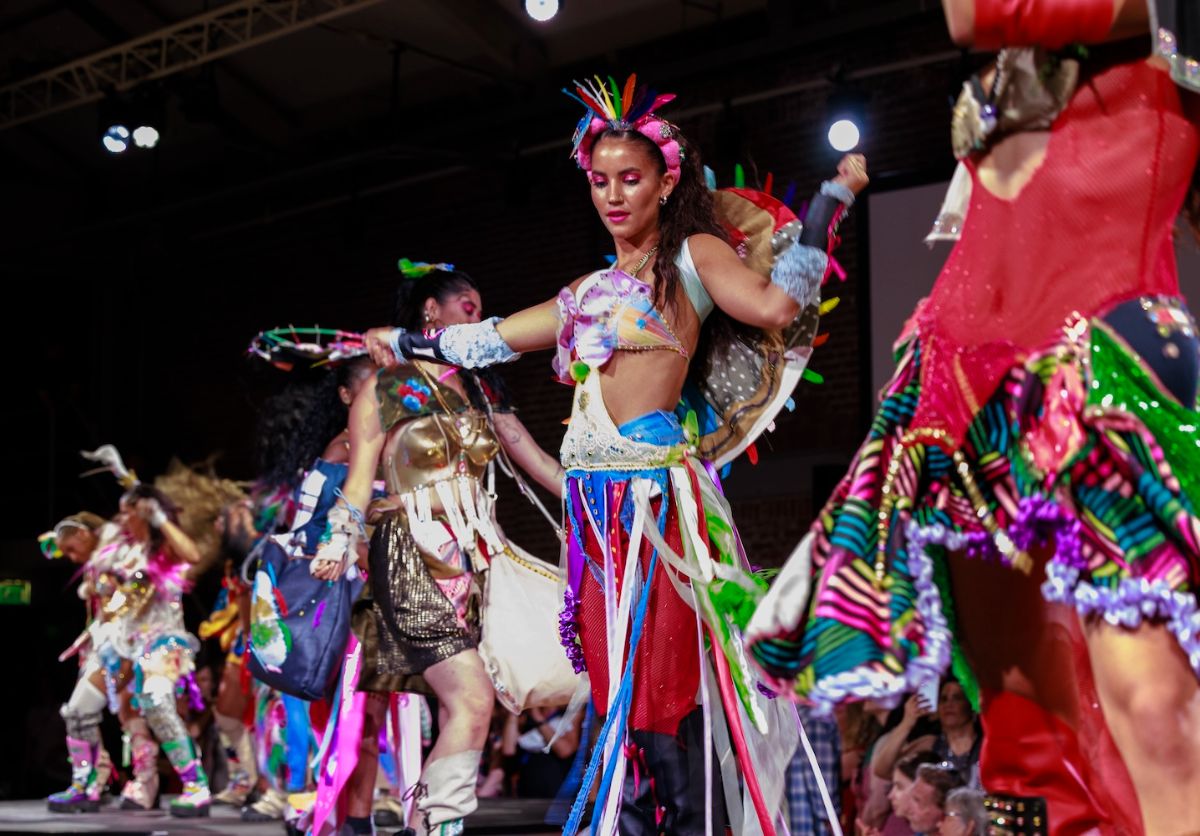
Feliz Aaliyah Sánchez Buitrago closed the evening in an explosion of colour, sound and movement, transforming the stage into a euphoric carnival of nostalgic pop-cultural references, spiritual symbolism and maximalism galore. Golden breastplates collided with glitter-covered corsets, tutus, latex strips and mermaid Lycra, while performers danced chaotically through the space in layers of denim laced together with bright pink cords, flower-print swimsuits and oversized hand-painted bags. The collection continuously balanced on the edge of visual overload, yet never lost its sense of joy. References to Colombian heritage, Musca spirituality, 90’s R&B aesthetics and personal family histories merged into a loud but deeply sincere visual language. At times bordering on complete cacophony, the performance nevertheless became one of the evening’s most memorable moments precisely because of its refusal to edit itself down. It was messy, overwhelming, theatrical and entirely committed to its own universe, qualities that perhaps best encapsulated the spirit of this year’s Rietveld graduation show as a whole.