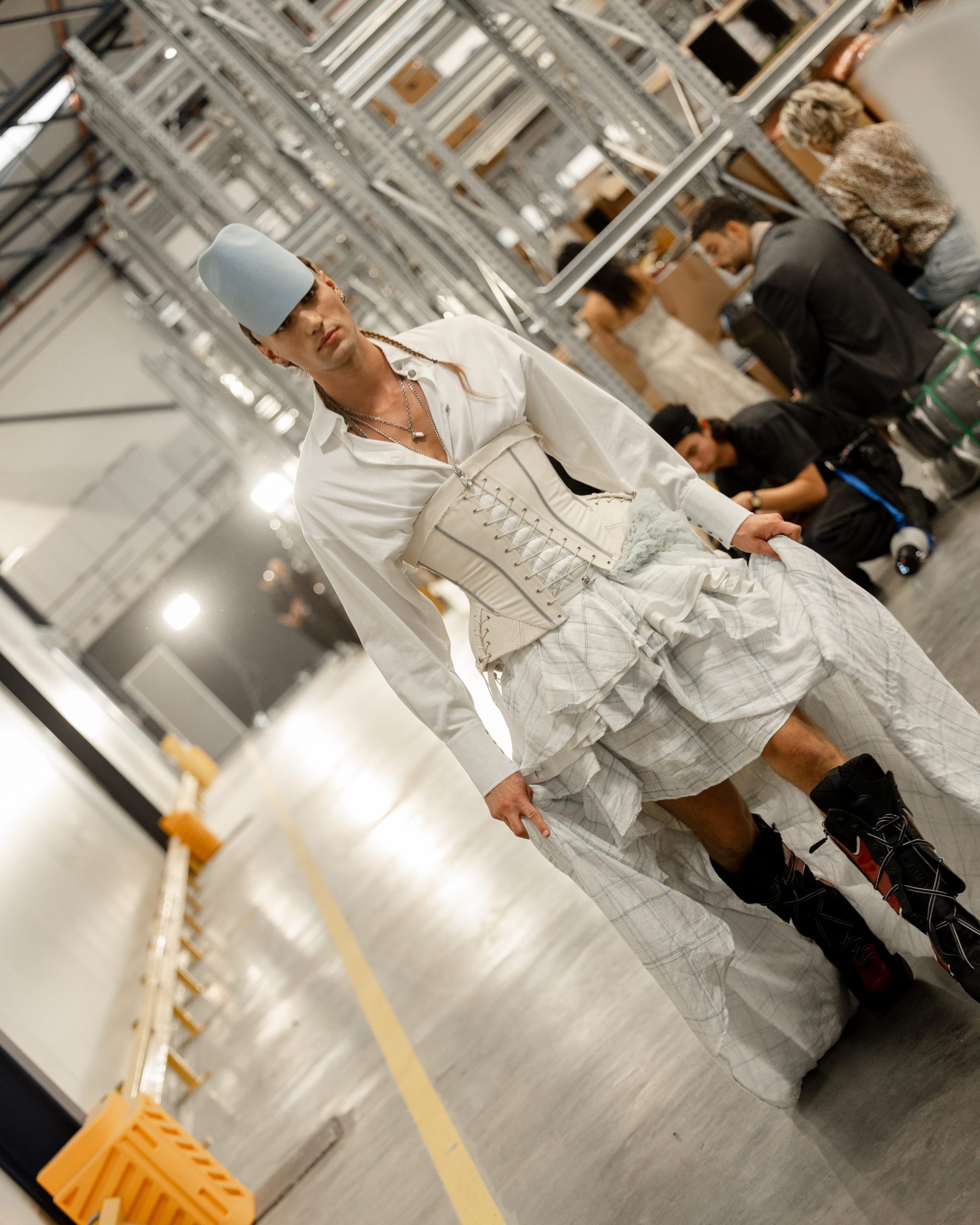
What does a fashion archive become when its creator lets someone else take the lead? For her 10-year anniversary, Tess van Zalinge handed over a decade of her work to a new generation, inviting founder of Dream Unit and stylist Evy Cornelie, model and stylist Dirkje Lemmink, and creative director and stylist Simone van Ommen to reinterpret her archive with complete creative freedom. Ten years after her Amsterdam Fashion Week debut, Van Zalinge returned to the official programme not to recreate the past, but to see where it could go next. The result was a punk-rock take on the Tess van Zalinge universe: ten years of couture on crack — and it was absolutely stunning.
Presented at Bright Fiber, a location built around transforming discarded clothing into new, high-quality garments, the setting immediately reflected the show’s central idea of transformation. In her opening speech, Van Zalinge described the decision to step back as an opportunity to let go for a moment and give space to a new generation. Her own role shifted from designer to facilitator, assisting the three creatives in following their vision and making their ideas possible.
The archive was treated less as something to preserve than something to play with. Familiar pieces were taken apart, repositioned and combined into unexpected new forms. A pink scrunchy corset top from the Klavertje Drie collection was lowered to the hips and used to hold the arms close to the body, whilst underneath, a structured body from the designer’s latest collection, Keurslijf, created an intriguing play between youthfulness and constraint. Elsewhere, sleeves were laced, punctured and stiffened around the legs, transforming into armour-like chaps. Corsetry was no longer confined to the torso, garments shifted across the body and styling became an integral part of reshaping the archive. Layer upon layer of contrasting fabrics decontextualised Van Zalinge’s oeuvre and amped it up into a rebellious dress-up party.
One model appeared with her chest held by gloved hands, her face covered by a sheer veil decorated with hand-sewn flowers, paired with light, bouncy trousers in the same fabric as the gloves. Another look layered a lacquered white bra beneath a sheer top, with a lace peplum, a red ruffled piece tied around the head and a long sheer train. Blush-coloured ruffled bloomers peeked out underneath, secured by a crinoline-like structure around the hips. As some looks called for a stomping cadence in heavy boots, others drifted through the space in ballet flats.
Despite their different individual aesthetics, Cornelie, Lemmink and Van Ommen approached the archive as a collective. As Cornelie explains, the three ultimately built all of the looks together rather than dividing the collection into clearly defined sections. Their different styles made the process challenging, but also allowed them to learn from one another and create silhouettes that could not have emerged from a single perspective.
That sense of community extended to the casting, with many of the models being friends or people the three creatives had worked with previously. It echoes Van Zalinge’s own approach to casting, which has long centred on surrounding herself with people she knows and trusts. For the anniversary show, that philosophy was passed on alongside the archive itself, with each creative bringing their own network into the Tess van Zalinge world.
Against the industrial setting of Bright Fiber, the combination of soft sheer fabrics, sculptural construction, vivid accents and harder, punk-inspired styling gave the archive a new energy — one that went beyond even their own expectations. All three creatives had initially associated Van Zalinge’s work with white, making the bold use of colour an unexpected departure. That same freedom extended to the hair, created by Keune as the show’s hair partner. Braids were deliberately left messy and undone rather than polished, adding to the collection’s playful, rebellious character. Keune’s new Color Muse system, built around mixing and personalising colour through concentrated pigments, complemented the show’s own approach to creative freedom and individual expression. The presentation ended with a voiceover featuring Vivienne Westwood, echoing through the warehouse as the models moved through the space. It was a fitting final note for a show built around questioning established forms and finding new possibilities within what already exists.
For her tenth anniversary, Van Zalinge chose not to simply look back at the work that defined her first decade. Instead, she handed it over. By allowing a new generation to dismantle, reshape and rebuild her archive, the designer turned ten years of work into raw material for what comes next, proving that a legacy can remain alive by continuing to change.
Image by Amber Dewi