There are birthday parties, and then there is a Patchwork Family birthday party. For its fifth anniversary, the multidisciplinary collective decided that a cake, a few balloons and an aggressively lukewarm bottle of prosecco simply wouldn’t do. Instead, Paradiso was transformed into a playground of sex, protest, drag, fashion and gloriously bad taste for The Grand Family Affair, a five-year celebration of everything that makes The Patchwork Family, well, The Patchwork Family.
It’s the end of AFW26 Day 4. Risen from the depths of every corner of Amsterdam, fashion obsessives, die-hard Patchwork stans and every gay within a five-kilometre radius gather at Leidseplein as the doors open fashionably late on what would become a very long night. Guests barge into the main hall of Paradiso and are welcomed with a glimpse of Remember Me, a fashion true-crime mockumentary by Becky Stabber. Developed during Paris Fashion Week, the film follows the collective’s fictional ascent to international fashion stardom, skewering the industry’s obsession with visibility, toxicity and the increasingly thin line between problematic and iconic. In other words: exactly the kind of fashion fantasy where pretending to have made it is arguably more fashionable than actually making it.
What followed was what everyone had been waiting for: the Best Of show, 40 minutes of sex, drama and extravaganza revisiting some of the collective’s most memorable moments through a new generation of makers and familiar faces. Hosted by Jeanpaul Paula, Jo.Joe and Juno Dijkshoorn, the presentation moved with the logic of a particularly feverish dream; one in which the dress code is couture, the concept is chaos and absolutely nobody has come to behave.
Elle Rusu opened with Fever Dream, and the name was hardly an understatement. Skimpy cut-out lingerie, lace halternecks, blindfolds, ruffles and stilettos collided in a procession of hyper-feminine silhouettes that seemed permanently on the verge of losing their balance, sometimes literally. One blindfolded performer stumbled across the stage, relying on two companions to keep her upright while navigating a wardrobe of sheer fabrics, microscopic lingerie and a neckline that seemed to have signed a personal vendetta against gravity. Elsewhere, nipple tassels became part of the dress. Naturally.
If that sounds excessive, Meike van Lelyveld’s Diner took the concept of dinner and threw the tablecloth directly out of the window. True to van Lelyveld’s previous performances, a collection of trash bags was quickly laid out on the floor. A white dress gathered around a stand became the stage for a gloriously disgusting girl dinner: grapes and nuts were stuffed into the main character’s mouth, whipped cream was squirted down her dress, yoghurt, probably the expensive kind, became a hair mask, and ketchup provided a raunchy flourish. The performer eventually removed her dress and wig, calmly sipped an espresso and walked off with her trash bags. Because nothing says post-dinner elegance quite like carrying your rubbish home.
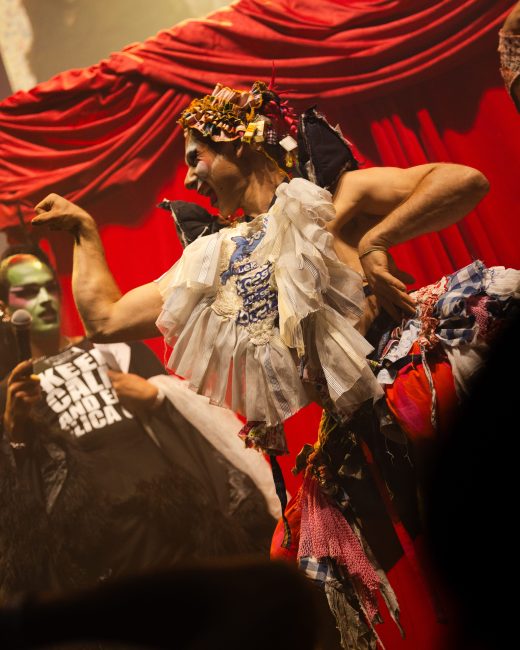
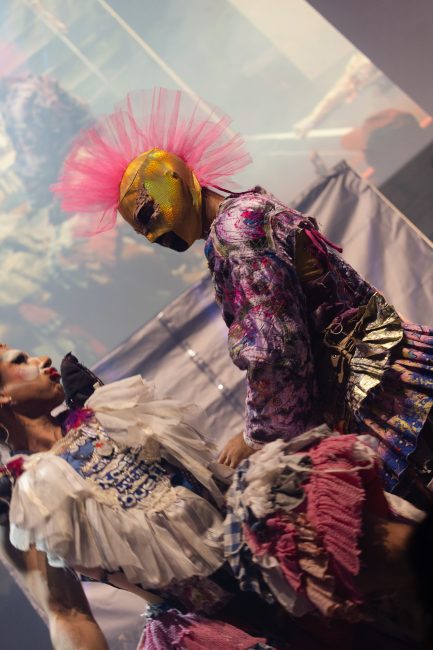
Things then got physical with Berber Struiksma’s Cage Fight. Jeanpaul Paula paraded a fighting belt bearing the words Grand Family Champion, dangling like the most questionable trophy in fashion history, while two competitors faced off in outfits that looked as though a children’s dressing-up box had been given an unlimited budget and absolutely no adult supervision. One appeared in a pink tulle mohawk, gold mask, pink laced-up corset armour and schoolgirl skirt layered over enormous patchwork track pants. The other emerged as a denim-clad clown, complete with ruffled bib, dragon shoulder pads and enough layers of fabric to furnish a small theatre.
The two proceeded to rip each other, and their clothes, to shreds, revealing layer upon layer of deconstructed garments until the fight ended somewhere between fashion show and full-blown striptease. It was an even fight, leaving both competitors wearing nothing but a golden teddy-bear-print bikini and a shiny onesie, spliced up on the side and laced up in pink. The winner was crowned in front of an image of the White House, because apparently even a cage fight needs a little political theatre.
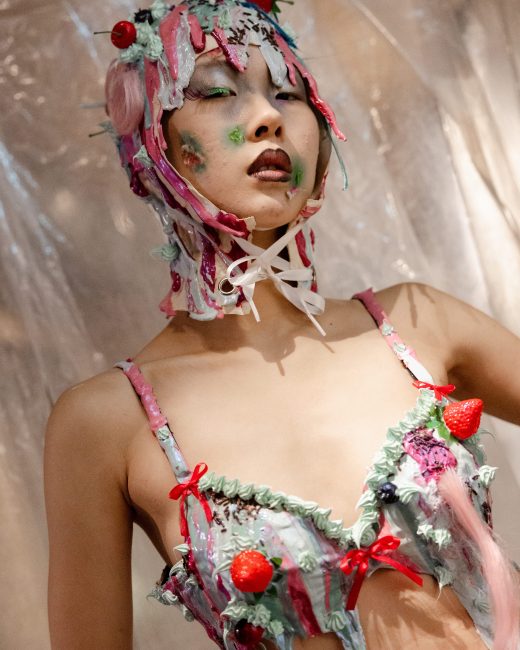
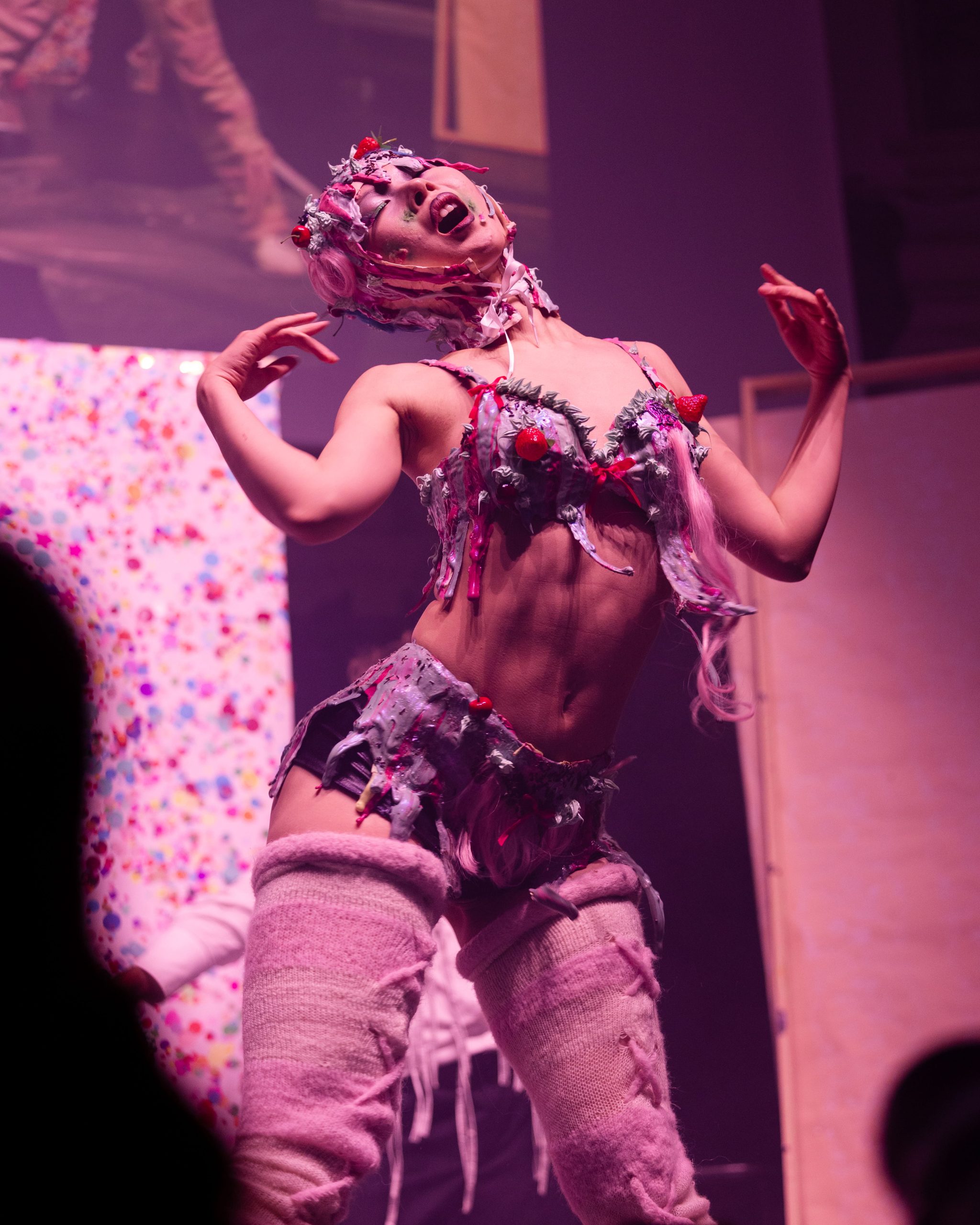
Then came Salome Jeanne’s Birthday Cake Destruction, which was exactly as subtle as its title suggests. A gigantic three-tiered birthday cake appeared, complete with wigs and cherries, before a highly bendable candy creature crawled out from inside it to the soundtrack of hardcore techno. Candy bras, pink extensions exploding from nipple cherries, a bonnet seemingly made from melted sweets, leather booty shorts and thigh-high cotton-candy socks transformed the performer into a walking sugar rush. The cake, meanwhile, did not survive the celebration. After emerging from it, the performer proceeded to destroy a miniature version with her ass. Happy birthday.
And because apparently one birthday wasn’t enough, Miss Tekna then burst through a confetti screen wearing one of Salome Jeanne’s standout looks from the previous year: a white dress with a muscular corset, feathered bustle and an excessive sprinkling of crosses. Another birthday girl. Another excuse for confetti.
Joris Jansen’s Fashionably Late brought its own brand of camp excess. “Why say diva like it’s a bad thing?” became the unofficial manifesto, with hyper-femininity, excess and absurdity turned into weapons against the expectations of polite fashion. The pièce de résistance was a white corset with exposed boning and stilettos dramatically protruding from the hips, paired with tiny lace-up briefs extending into an exaggerated chapel train. Because why make an entrance when you can make an obstruction?
And then, because no Patchwork Family affair would be complete without a little political intervention, the party took a more serious turn. The world is burning, the opening monologue reminded us, before a red-painted performer in a diamond thong delivered an emotional manifesto on equality. The crowd was asked to raise its voice, ending in a collective cry of “Free Palestine”. Even at its most ridiculous, The Patchwork Family has never been particularly interested in keeping fashion and politics in separate rooms.
But before anyone could get too earnest, a giant net filled with balloons was dropped into the middle of the room as performers and dancers took over the space, the celebration reaching its inevitable climax in a glorious collision of bodies, latex, music, confetti and general sensory overload. Somewhere in the chaos, the collective even broke a world record. The exact details almost seemed beside the point. This was less about keeping score than proving that, five years in, The Patchwork Family still knows how to throw a party.
After the show, Paradiso became the Grand Afterparty, with DJ Europarking, Faggatron, Slimfit and YoungWoman taking over the floor, while the basement became an archaeological excavation of Patchwork Family history. Among the relics, Patchwork Family took one last opportunity to give the people exactly what they came for: the sexiest, dirtiest performances of the night. Upstairs, the true fans lined up for Family Affair airbrush tattoos.
Five years of creativity, collaboration, chosen family, sexy protest and spectacular bad taste had officially been condensed into one night. The Patchwork Family may have turned five, but if The Grand Family Affair is anything to go by, growing up is very much not on the agenda.
Images by Amber Dewi