Last year, Vince Reece Hale was among the emerging designers selected for Amsterdam Fashion Week’s Op de Ring show, presenting his work on the A10 alongside established names in Dutch fashion. This September, he returned to the AFW schedule with his first solo show, Indigo Beam. With just two months to create twenty looks, the lead-up involved four-day denim marathons in Italy, late nights, last-minute decisions and a network of creative collaborators helping bring his vision to life. From experimenting with denim washes to coordinating production and finishing garments hours before the show, Hale navigated the many moving parts of staging a runway show as an independent designer. We caught up with him to discuss the highs, the hurdles and the realities of bringing his vision to the AFW runway.
This was your first solo show on the Amsterdam Fashion Week schedule. What did this step mean to you as a designer, and how did you experience the lead-up to the show?
After the Op de Ring show, I’d fallen into that post-show emptiness. I wanted more. The very next day, I already wanted to get back behind my sewing machine, but I thought: I have absolutely nothing to work towards now.
I remember going to a panel talk at the OBA, where I ran into Danie. I wasn’t there with any particular mission, but at one point I jokingly said: “I’ll see you next year.” And she replied: “Okay, do you have a pitch?” I said: “Not yet.” So she told me to come back with one and we’d see.
From that moment, something started moving in my mind. I’d never pitched anything like this before, so I really wanted to do it properly. I spent months improving that presentation, adapting it and working out every little detail. The first thing Danie told me was: “You’re too late.” But I don’t regret taking my time, because I put every second into that presentation and the collection. She eventually told me she’d rarely seen a concept where absolutely everything was so clear. She also told me there was absolutely no chance of getting an evening slot. No chance whatsoever. Then, the following day, Lisanne called me and said I could close Amsterdam Fashion Week.
So yes, going from opening the Op de Ring show to closing Amsterdam Fashion Week was a real full-circle moment for me. It’s funny, because everything comes together in one single moment. We’re sitting here doing an interview about one show, but it took me ten years to get here.
You’re known for approaching denim in unexpected ways, but presenting those experiments on the runway brings a different set of challenges. Did preparing for your first solo AFW show change the way you developed the collection?
I try to create four or five drawings a day, and over time I’ve built up this enormous archive. By the time I started working on Indigo Beam, I’d actually already sketched five or six collections. That’s just how I work. My sketches range from couture to genuine ready-to-wear, so suddenly having to produce a collection wasn’t particularly overwhelming. What was different this time was finding the right balance. My previous collection was very fairytale-like, with veils and a much stronger couture direction. For this show, I wanted something more balanced, partly because there were twenty looks this time, twice as many as before.
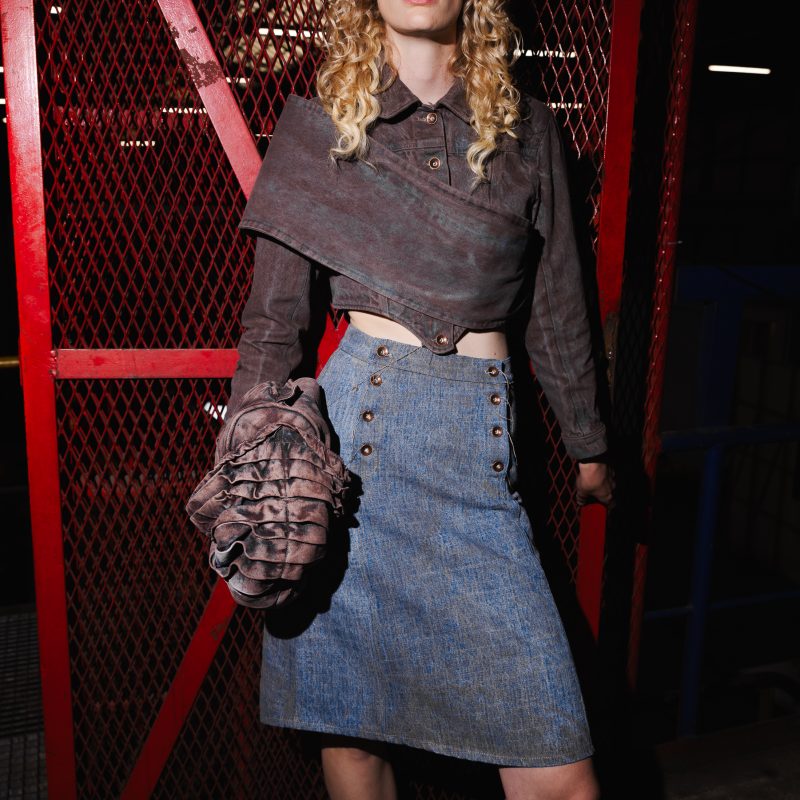
I also saw it as another business card. I wanted to show all the different possibilities of denim, from something more commercial to something much more elevated. There are definitely pieces in the collection that could be sold in stores, but there are also more experimental designs. Personally, I naturally lean towards couture. But I think I’m learning when to hold myself back. If you saw all the garments in their raw state, you might consider it a ready-to-wear collection. Not the kind you’d necessarily fold up and put on a shop shelf, but runway ready-to-wear. And then you have all these elevated details, like a draped scarf incorporated into a sleeve or a skirt treated with resin to create depth and structure.
And then there are the washes. That’s almost an entirely separate collection in itself. You have the process of sketching, pattern cutting, sewing and constructing the garments, and then you essentially start all over again with the washing process. It’s like having two collections in one, except you can’t separate them because they exist on the same body.
Indigo Beam presents a striking variety of characters, from romantic to rebellious and refined to raw. How did you use denim to give each character their own identity while maintaining a cohesive collection?
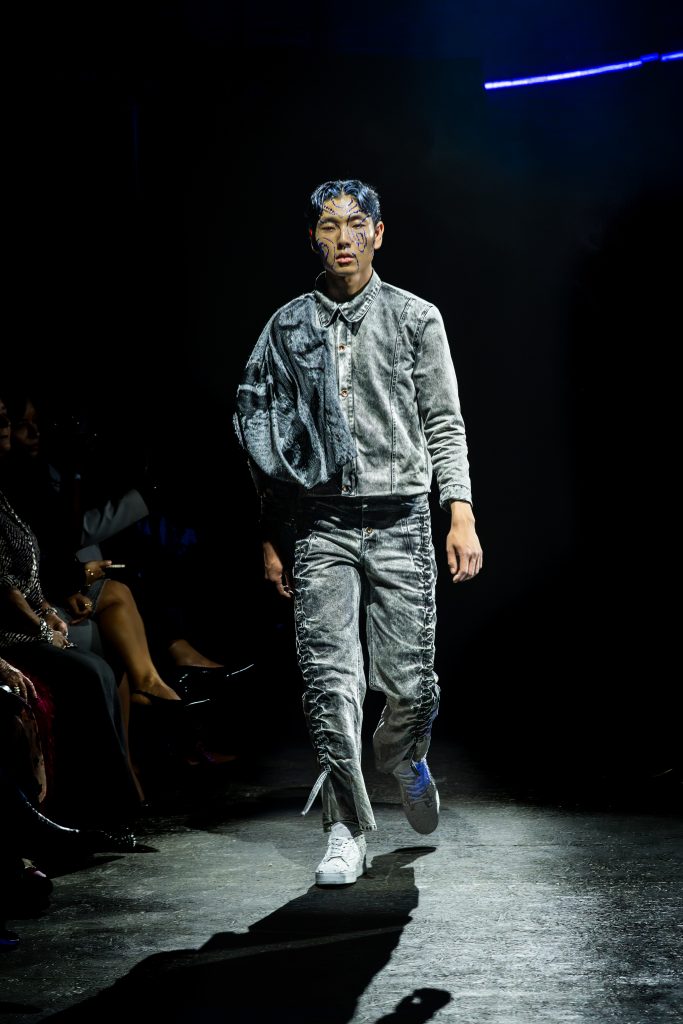
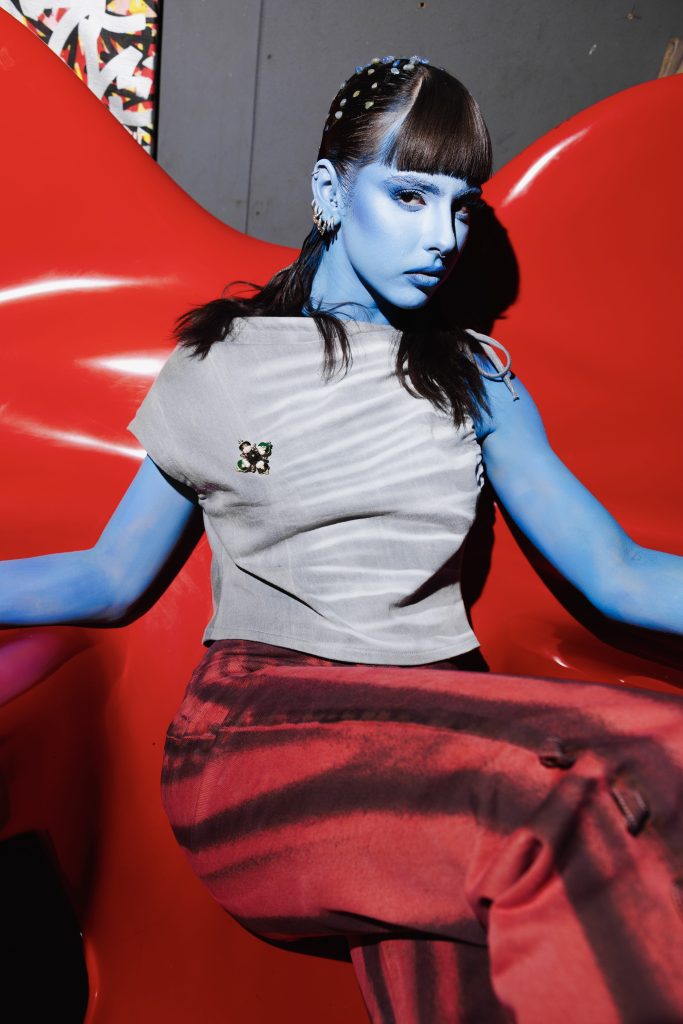
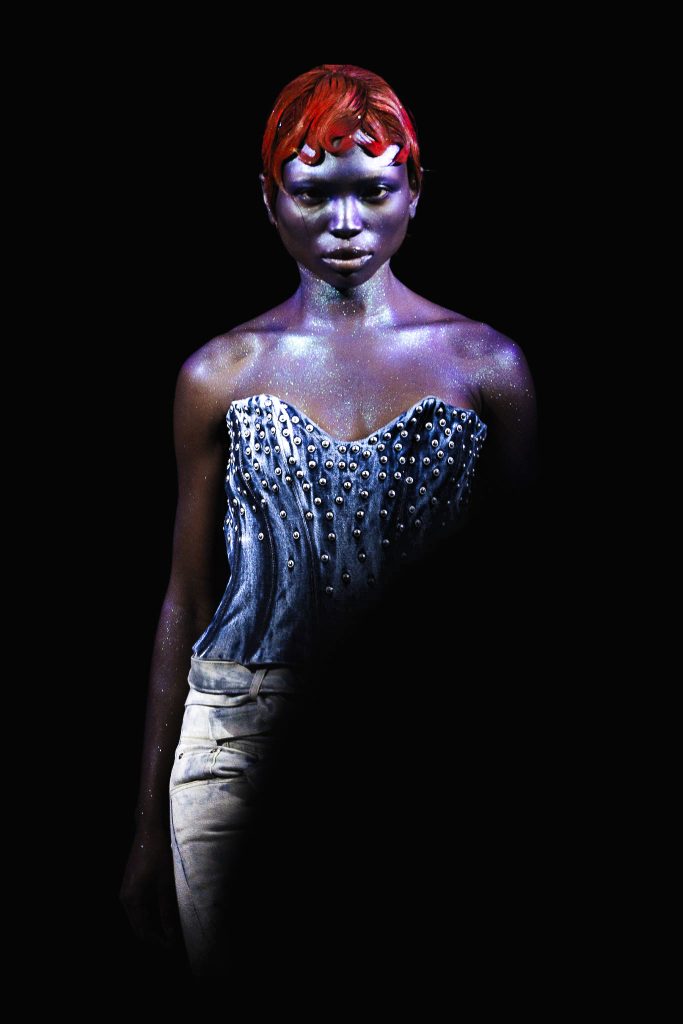
Even during my preparations with MAC and Sebastian Professional, there was already a very character-driven approach. Each character had their own key elements, and I knew exactly what I wanted for each individual model. Everything was quite extreme, but I think that’s exactly how you create an identity for each person. By pushing those extremes.
There was someone who was completely blue, for example, and someone else with dents on their face and blue contact lenses, which is something I’d also done at the Op de Ring show. I brought quite a lot of that world back into this show. That futuristic feeling, very elegant but also somehow not. Almost porcelain-like, but with lots of colour. It’s naturally quite extra, but that’s what I like. And it’s something I want to keep repeating in future collections. I’m creating this world in which certain characters can return.
That also applies to the washes. They’re really the starting point for me, alongside the clothing itself. I don’t necessarily sketch fully developed characters. My focus is always on the garments, their details and what I want to translate into 3D. The characters develop through ideas and imagination. I’ve now visited Officina +39 in Italy twice, and they’ve genuinely become like family to me. Everything they do is rooted in more sustainable processes, and I find the chemistry behind denim washing so incredibly interesting. It’s basically pure chemistry in there. I’ve been immersing myself in that side of the industry for about five years now.
To be honest, I almost see more of a future for myself in that than in designing. Don’t get me wrong, I’ll always design. I sketch every day, and I’ll continue doing that. But sometimes people ask where I see myself later, and I tell them: as a laboratory technician. Somewhere at Diesel in Italy, sitting in this beautiful lab, experimenting with all kinds of washes. Hopefully still creating my own collections once a year, of course.
The lighting, smoke, music and movement were just as defining to Indigo Beam as the clothing itself. What feeling did you want to evoke in the audience, and how did you translate that into the final show?
I’ve had this fascination with lasers and lighting for a very long time. I also love music. I used to make it myself, but eventually I went down the fashion route because music wasn’t entirely where I belonged. Fashion is my core, my daily routine, but I’m interested in so many different things. And I love creating an experience. Even at the Op de Ring show, I was asking the backstage crew all these questions because I wanted rose petals to fall from above, because of my golden bouquet. And everyone kept telling me: “You should save that for when you have your own show.” But I just wanted to give people that experience. I don’t necessarily want to be extra for the sake of being extra, but I want to think about everything. Especially what someone experiences as an individual.
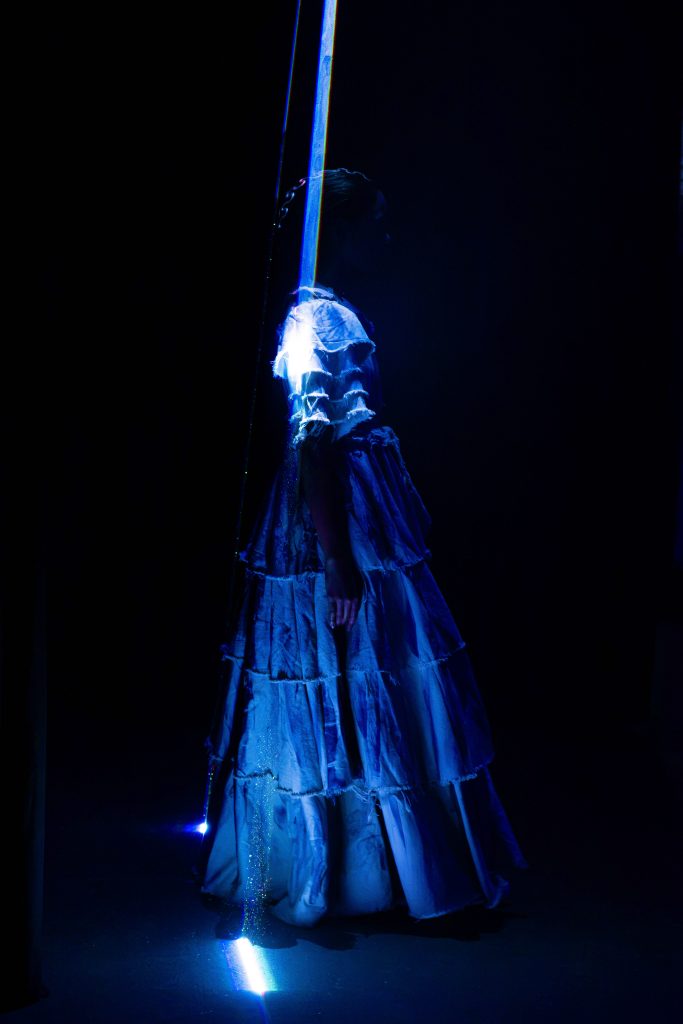
I’ve also taken a lot of inspiration from NXT Museum. I’ve been there three times, and every single time I leave thinking: wow. It’s almost like entering some kind of trance. Like you’ve just watched an incredibly long, intense film. You come out feeling high, you know? You need a moment to recover. That’s what I wanted to create with Indigo Beam. We’re constantly overstimulated by social media and everything around us, so I wanted to offer people a moment where they could genuinely experience something. The music, the lighting, the shadows, the models emerging through the laser beam – everything needed to contribute to that feeling. I didn’t want to approach the show in the most traditional way possible.
The funny thing is that you never actually get to experience your own show. I wasn’t there. I was backstage, and we didn’t even have a monitor. Nothing. So I don’t really know what it looked like from the audience’s perspective. I can only hope that people experienced at least some of what I’d imagined.
A show of this scale is never created entirely alone. How did the partnerships and creative collaborations behind Indigo Beam come about, and what role did they play in bringing your vision to life?
Oh, there were so many creative people involved. It’s quite a long list. Starting with Pre-reserved, which is a beautiful location I already knew really well. That gave me the opportunity to explore the space, develop ideas and test different possibilities.
The lighting and lasers were very much developed from my own perspective. I spent an enormous amount of time researching lasers, looking at references like Kraftwerk in Berlin. I even put together a fifteen- or twenty-minute compilation in Premiere Pro, with all these visual references set to music.
For the music itself, I worked with Beer Petrie, a longtime friend of mine who produces music for artists including Roxy Dekker and Ronnie Flex. I’ve known him since I was twelve or thirteen, and we’d always wanted to collaborate on something. This was finally our moment. I went to his studio and basically just talked about my collection. I showed him my sketches and moodboards, and two days later he’d created an entire track for me. Two days! And naturally, that track had a huge influence on the lasers too.
For the lighting, I approached Vincent Peeters, who I knew from a bar I used to work at. I’m the kind of guy who’ll secretly start chatting to the people behind the lighting desk because I’m interested in what they do. When I approached him with the concept, he immediately wanted to help. He appreciated my enthusiasm and big ideas, and together with Frans, we developed a really nice creative dynamic throughout the lighting production.
Filling Pieces was another special collaboration. For my final presentation at Jean School, I’d actually done an entire project on the brand, so I’d been following Guillaume’s work since 2018. Then I met him last year during the Op de Ring show, which was another little full-circle moment. I wanted to maintain that Amsterdam connection, and Filling Pieces felt like the perfect fit. His work is clean and aligns beautifully with the kind of elegance and purity I wanted to create.
When I approached him, he actually told me that if I’d come a month earlier, we could have developed an entirely new pair together in Portugal for this show, and I just looked at him and said: “No, no, no! I actually want to work with your old stock.” And he immediately replied: “Oh, of course. Just tell me what you need.” It was that easy. He gave me twenty pairs and basically told me to go wild.
I call myself a one-man mission because I don’t have a team, but I definitely couldn’t have done all of this without the people who supported me.
Was there a moment during the preparations when you thought: ‘How on earth are we going to pull this off?’
I think the biggest challenge was the timeframe. I had two months to create twenty looks, essentially by myself. I’d stopped working at the coffee place to dedicate myself entirely to the collection, and I needed to have everything ready to take to Officina +39 for the washing process. You have this blank canvas in front of you, like a painter, and suddenly you have to start painting. You can rush through it, but then you might end up with some very strange paintings. Luckily, I’d spent over two and a half years teaching students at AMFI and Jean School, so I was incredibly well prepared. I knew their products, recipes and techniques, so we could get straight to work. We managed to finish twenty looks in four days. Four days! I swear, it was absurd. But there’s always the risk that something goes wrong. Washing is an entirely separate discipline. You’re no longer pattern cutting or sewing; you’re working with a finished garment, and one mistake can ruin the entire piece.
Then there were the final days before the show. The Filling Pieces shoes only arrived a week beforehand. I’d just returned from Italy with all these coatings and ideas I wanted to use on them. Everything was ready, except there simply wasn’t enough time. I was still finishing garments the day before the show. My friends Tim Christiani and David Tressel joined me at the atelier for those final few nights, helping me finish around six looks. And the other fourteen? I must have finished those somewhere in the middle of the night. I honestly don’t remember any more. But I’m also the kind of guy who enjoys that challenge. Just give it to me.
What happened behind the scenes of Indigo Beam that the audience would never have known about while watching the show?
I was actually ill for the two days leading up to the show. I was still half ill on the day itself. It was stress. So much stress. There’s a perfectionist in me, and as a creative person, I’m also an overthinker. You have all these late nights, you’re creating twenty looks essentially by yourself, and at a certain point, it really starts to affect you. And there are so many things involved in organising a show that you completely underestimate beforehand. I had to be switched on for absolutely everything, even things like the seating arrangements. Luckily, my two sisters helped me with that. Rae has been a manager at IJland for eight years, so she knows exactly how these things work. And Lena works in fashion marketing, so she was a massive help too.
Something else the audience probably didn’t realise is that the laser concept was originally quite different. The lasers on the roof looked incredible, but we’d initially planned to have lasers on the ground, creating a much more active experience. We were working with Frans, who’s been building lasers since 1984. He’s in his sixties now and joined the project purely out of love for it. And he makes these incredibly powerful lasers out of the smallest little devices. It’s so cool. But because of that, we couldn’t direct them towards the audience. If people filmed directly into the beams with their camera lenses, it could cause problems. We’d have had to change the entire seating arrangement, placing everyone in a square around the central space. And that just didn’t work in my head. So we had to adapt.
Not everything turned out exactly as I’d imagined, but of course, the audience doesn’t necessarily see any of those compromises. They just experience the final result. And maybe that’s a good thing.
Now that Indigo Beam is behind you, what are you most proud of, and what will you take from this experience into your next show?
I think what I’m most proud of is that I actually managed to bring this entire world together, which had previously existed only in my imagination. Twenty looks, all that variation, all those different techniques, but hopefully still with a recognisable thread running through everything. I’ve been working towards this for ten years, and now I’m finally getting these moments where I can show people what I do. It’s funny because everyone sees the final show, but they don’t necessarily see the ten years that went into getting there.
And what I’ve noticed since is that people are starting to approach me because they want to support me or help out. They’ll ask whether I’m looking for interns or offer their help in other ways. That’s something that comes from doing a show like this.
There’s also that strange emptiness afterwards. I experienced it much more intensely after the Ring, but it’s always there. You finish this enormous project and suddenly think: what’s next? I’m someone who can’t sit still, so luckily I’m already sketching and working behind my sewing machine again. I have so many ideas for the next collection, and this time I can start much earlier.
One thing I’d like to explore further is creating a clearer distinction between ready-to-wear and couture. For example, having the first twelve looks entirely ready-to-wear, followed by twelve couture looks. I think that contrast is something I missed a little this year. And I want to continue building this world, with recurring characters, experimental washes and different ways of creating an experience.
I’m not there yet, you know? Actually I run with the mentality that I will never be ‘there’. It’s a never-ending journey, a bit like a pair of jeans that starts out raw and keeps evolving until its very last thread gives way. But this show has given me so much motivation to keep going.
https://www.reece-hale.com