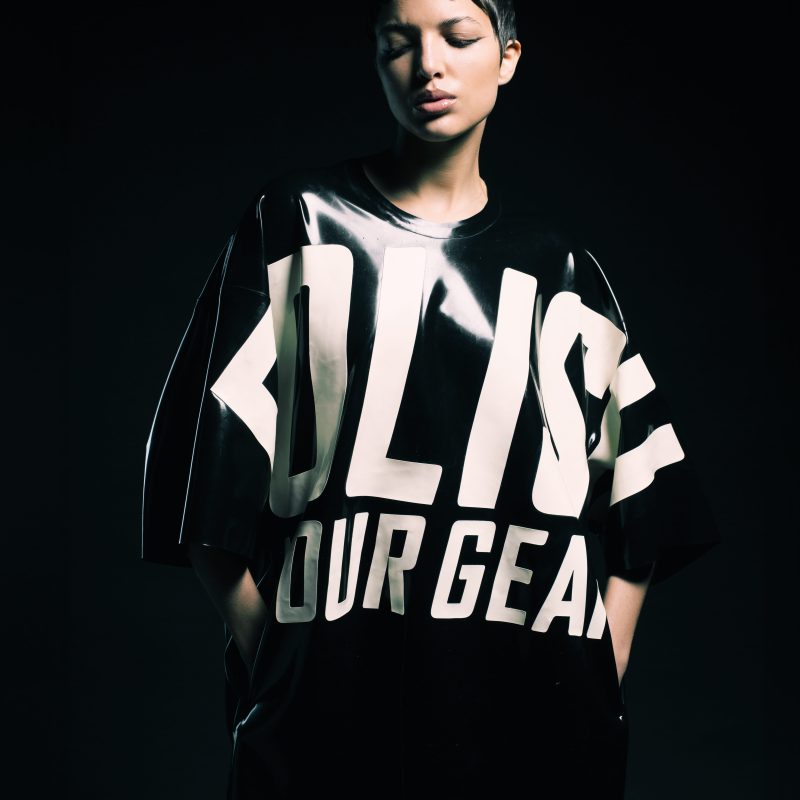
Founded by Karolina and Daan, Amsterdam-based brand POLISH YOUR GEAR is carving out its own space for latex, taking the material beyond its familiar skin-tight associations and into the realm of experimental ready-to-wear. For AFW26, the duo joined the Amsterdam Fashion Week schedule with their debut SS27 collection, drawing on motorcycle culture, personal heritage and the idea of identity as something we shape for ourselves. The presentation was followed by a pop-up at SPRMRKT, extending the conversation beyond the runway and bringing their world to a wider audience. We caught up with Karolina and Daan to talk about the story behind the label, the creative partnership that brought it to life and what lies ahead.
POLISH YOUR GEAR was founded by the two of you shortly after your time at Amsterdam Fashion Institute. You initially met during a group project, before going on to collaborate on Karolina’s graduation collection. What made you realise there was potential in turning that project into a brand?
Daan: “I started in the Dutch-language programme and then moved to an international class in my second year. That’s where we met. We were put in the same group for a project, and that’s actually when I first started experimenting with latex.”
Karolina: “We were working on a group project where we had to imagine ourselves as the creative director of Gucci. It was just after Alessandro Michele had left, so the brief was essentially to consider who could come next, what direction the brand could take and how we would transform it. I started researching latex and really wanted to introduce it into our design toolbox. A lot of people in the group were against it because they thought nobody would use it apart from me. Daan was one of the few who said, ‘No, I think we should include it.’ Daan dropped out in the third year, but we remained friends. When I got to my graduation year, I decided to make my entire collection out of latex. Halfway through the process, I realised how much work it was going to involve and that I needed help. I knew I could count on Daan and called him up, and the rest is history.”
Daan: “I think we really found each other during her graduation project. We have a very similar way of working and thinking about construction, and we both enjoy making things quite challenging. After graduation, we were at a bit of a crossroads. Karolina was potentially going to move to Paris, but that fell through, and we were both still here. Most of our friends had either already graduated, moved back home or decided to pursue other things. We were a bit stuck, and then we thought: actually, this worked really well, so why not give it a try?”
Karolina: “In the beginning, it wasn’t particularly serious. We were just thinking, ‘Let’s do something together.’ I remember going on holiday to Spain after graduation and sitting by the swimming pool, smoking cigarettes, when Daan joked, ‘So, when are we buying the laser machine?’”
How do your individual perspectives come together within the brand? Karolina, you initially introduced latex into the picture. Has that division of roles remained the same, with one of you more focused on the material and the other on the creative direction?
Daan: “I think you’re still very much the designer. You have a great eye for detail, whereas I maybe care a little less about some of those things. I really enjoy the making and the hands-on aspects.”
Daan: “I like creating patterns on my computer. I’m the laser operator!”
Karolina: “Exactly. Daan also likes starting new things and experimenting. I tend to prefer the production side of things.”
Daan: “She enjoys the middle and the end of a project, whereas I mostly enjoy the beginning. I think those interests complement each other really well.”
Latex is a material with fairly established associations, often linked to fetishwear, performance and nightlife. You seem interested in challenging those perceptions by bringing it into everyday wardrobes. What initially drew you to latex, and what do you think it can offer that other materials cannot?
Karolina: “I think the main thing we enjoy about latex is the challenge it presents in terms of construction. You often see it used in skin-tight, single-layer garments. We also work with those silhouettes, but incorporate more intricate motifs, prints and patterns. What we enjoy most, though, is combining latex with other materials. That allows us to create more structure and experiment with different silhouettes, rather than limiting ourselves to skin-tight garments.”
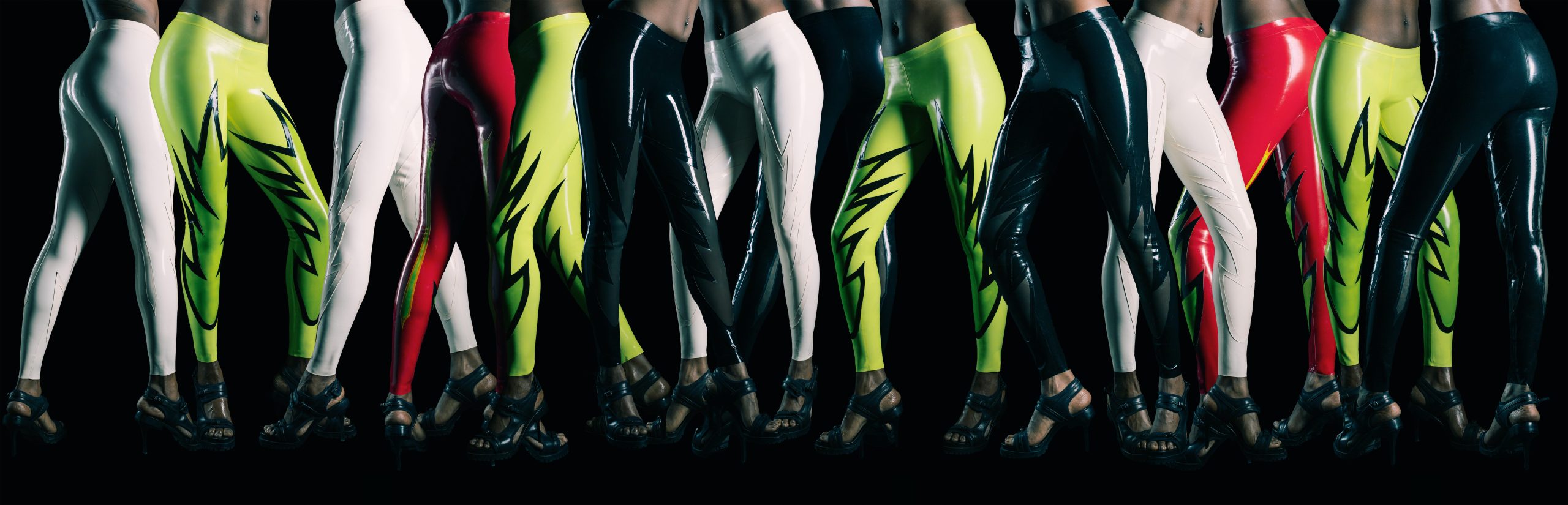
Is it important for you to completely break away from those existing connotations, or do you still want to pay tribute to them while offering something different?
Karolina: “I do want to break away from those connotations. I don’t want to design with people interested in fetishwear in mind, because then the garments would have to serve a particular function, such as having a zip at the crotch or something similar. That’s simply not what I’m thinking about when I design. At the same time, I’m not going to be afraid that every time I make a skin-tight garment, people will automatically associate it with fetishwear. So it’s about expanding the possibilities of what this material can offer.”
You develop and produce all your garments in-house, with a strong emphasis on precision and craftsmanship. What are some of the challenges of working with such a specific material, particularly when you’re trying to make it more accessible and wearable?
Karolina: “Perhaps we should start with the material itself. Everything is done by hand and glued together. It’s almost like working in a laboratory. We have benzene, glue, baby powder and all sorts of different things. The workspace has to be extremely clean because even a little dust can get into a seam. Latex is a very unforgiving material. It remembers everything that comes into contact with it. Even if you remove something that has stuck to the surface, the mark can remain.”
Daan: “That’s definitely one of the biggest challenges: maintaining a clean working environment. You really have to think about it and take care of it throughout the entire construction process.”
Karolina: “As for daily wearability, that’s something we’re still learning about. For our Spring/Summer 2027 collection, for example, we experimented with white latex. We already knew it could be tricky, especially because it stains so easily. Even in the studio, we were struggling with it. Once a stain appears, it can be incredibly difficult, sometimes impossible, to remove. It can happen through contact with low-quality hardware or jewellery. When we lend pieces to stylists, for example, we always have a loan agreement, but occasionally someone might accidentally touch a garment with a brass ring on set.
We’re slowly discovering ways to treat these marks, but sometimes it involves putting a garment through the washing machine as many as 40 times. That’s obviously not sustainable. So one of our biggest lessons from this collection is that, if we want to make our garments more wearable, we need to be mindful of things like colour choices.”
Daan: “I also think it’s about making the garments easier to put on. If you’re experienced and know what you’re doing, you can dress yourself in skin-tight latex, but I think a lot of people need help getting into something that fits that closely. That’s why we’ve also been experimenting with more oversized pieces. I really like the look of them, and it’s something I haven’t seen much before, which makes it particularly interesting to me.”
POLISH YOUR GEAR seems to attract a rather distinct crowd, with a strong connection to creative communities. Who are the people you see wearing your designs, and what do you think draws them to the brand?
Karolina: “I think the main things that attract people are the colours and the structures. We create quite voluminous shapes using a material that doesn’t naturally lend itself to that. There’s also something about the visual impact of it. It’s quite eye-catching.”
Daan: “We actually found this question quite interesting because we were wondering how other people perceive our target audience and the people who wear our clothes. I don’t think we have a clear answer yet. There’s quite a broad range of people.”
Karolina: “Stylists who are a little more daring tend to approach us, and they often dress artists who are similarly bold. That has helped shape the way people perceive our brand. But we were also discussing how the people who actually buy our clothes are quite a different crowd.”
Daan: “I think that’s partly because we’re still figuring out our pricing. For the more creative community we want to reach, our pieces might currently be a little too luxurious and outside their price range. That’s something we’re looking into: how to create pieces that are more affordable and accessible without losing our identity. I think that creative community is ultimately the audience we want to reach. It’s now about finding a way to cater to them while staying true to the brand, and finding the right balance.”
During AFW26, you presented your debut SS27 ready-to-wear collection, exploring identity, heritage and freedom through contemporary interpretations of motorcycle culture. The collection is also inspired by Suki, a fictional rider. Could you tell us more about her story and how she became the starting point for the collection?
Karolina: “I find the beginning of every collection quite difficult because I feel it has to be very personal. But when you make something so personal, it can easily become a cliché. For this collection, I decided to create an alter ego of sorts, whom I called Suki. She’s rebellious and manipulative — someone who craves adrenaline and freedom. Creating this character helped me bridge the gap between my cultural background, as I’m Polish, and the environment I’m currently surrounded by.
Suki is also Polish, but she has never lived in Poland. She’s the daughter of immigrants and has a close relationship with her mother and grandmother. She explores her cultural heritage through her grandmother’s home, the fabrics and objects she discovers there. There’s a skirt in the collection, for example, that’s shaped like a lampshade. It was inspired by a lamp my grandmother used to have. If you look at the prints throughout the collection, you’ll notice that they’re quite traditional. There’s traditional lace, little ducks and small houses. But these references are translated into a more contemporary material. In a way, Suki represents the contrast between what was given to her, her cultural background, and what she has chosen to become. That’s where the motorcycle references come in.”
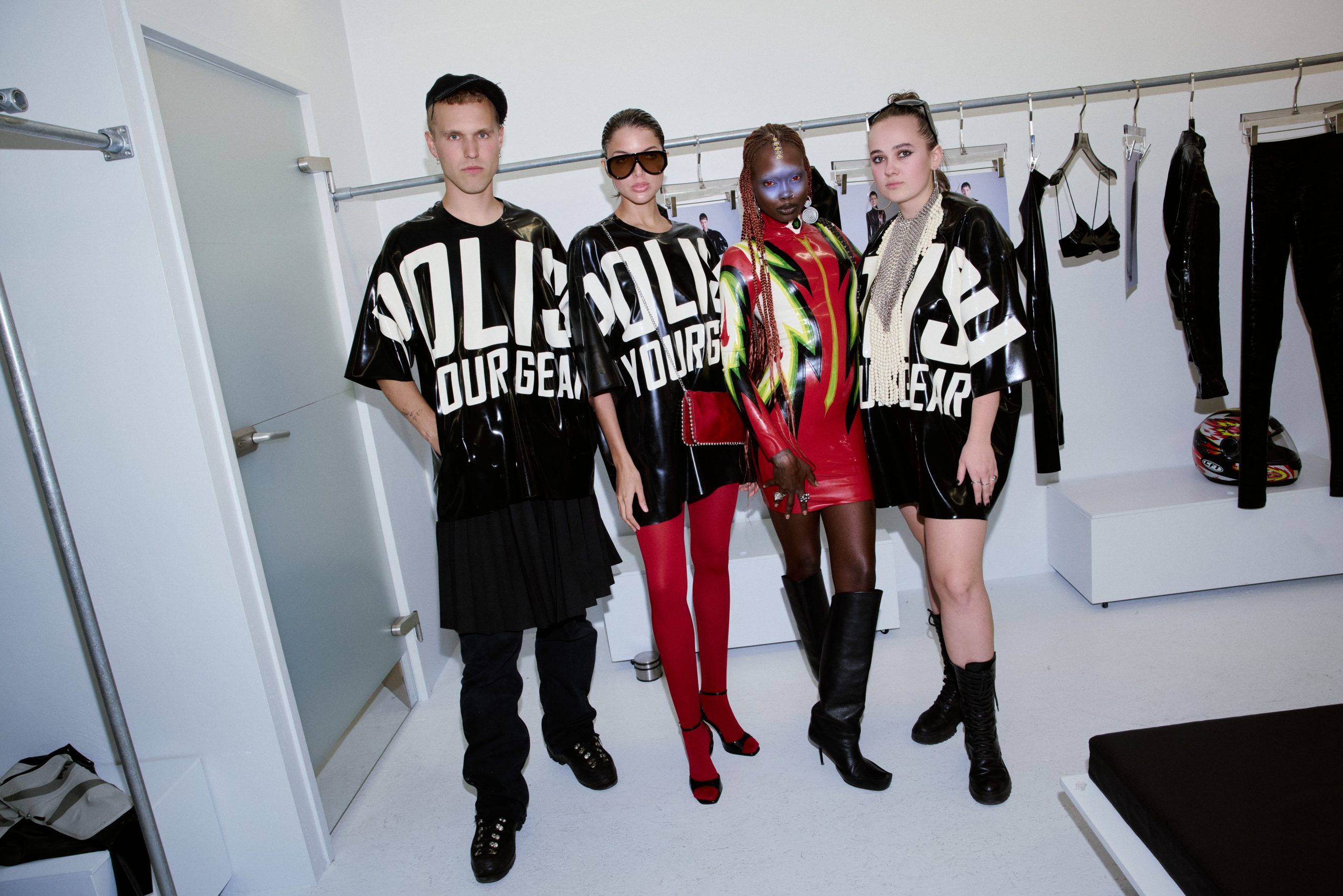
The AFW event received quite a lot of attention. What was the response like, and did you expect it to be so successful?
Karolina: “We were really surprised by how successful it was. We definitely didn’t expect that many people, and we certainly didn’t expect people to be waiting outside before the event had even started. We were quite short on time, to be fair. I think we only had two hours to set up the entire event because we were hosting it in the store, so it was quite stressful. We still had to get changed, do our make-up and everything, but by ten to six people were already standing outside. I was like, ‘Oh my God!’
Quite a lot of nice things came out of the AFW event, too. For example, the SPRMRKT pop-up during ADE came about through that event. We invited them, they were really impressed and excited about what we were doing, and they invited us to collaborate straight away. So that was really nice.”
Your recent encounter with An Vandevorst and Filip Arickx at SPRMRKT seems like a particularly full-circle moment, considering how influential A.F. VANDEVORST was to you as emerging designers. What did that meeting mean to you, and what is it like to have the work of designers you once looked up to now become part of your own professional journey?
Karolina: “We never expected that meeting to happen. At our event, the owners of SPRMRKT told us that An Vandevorst would be attending to DJ and give a little talk. We were like, ‘What? An Vandevorst?’ It felt like a full-circle moment because our design teacher at AMFI had previously worked for A.F. VANDEVORST and often used the brand as a reference in her classes. We had even used a pair of A.F. VANDEVORST shoes, which we used to style our collection. On top of that, our photographer was also in contact with An, so we were incredibly excited about the possibility of meeting her.
We immediately thought we should make something for her, so we decided to create a custom T-shirt. Some people at the event were wearing our original T-shirts, and we had also made a special version for SPRMRKT that said ‘Polish SPRMKRT’, which we gifted to them as a thank you for inviting us. An noticed the T-shirt and asked, ‘Wow, are you guys selling these T-shirts here?’ We thought, okay, we definitely need to go and talk to her now!
They were both so lovely. I genuinely didn’t expect such kind words from them. I thought it might be a quick one-minute conversation, where we’d exchange a sentence or two, but it turned into such a lovely interaction. It was really motivating to hear what they had to say.”
How did you approach designing the custom T-shirt for An? I imagine there was quite a bit of pressure involved.
Karolina: “We were so nervous, but also honoured. In the end, we kept it quite classic and played it safe. I also still follow An on Instagram, so I have an idea of what she wears nowadays. I definitely kept that in mind when designing it.”
SPRMRKT has historically played an important role in introducing experimental designers and supporting emerging talent in Amsterdam. How important are independent platforms, shops and creative spaces in giving niche labels like yours visibility and helping them find their audience?
Daan: “I think it’s an interesting relationship because there’s always a certain power dynamic. They’re the established party, after all. But I think it’s great that they use their reach to support emerging designers. It’s really nice to hear that your work is considered good enough to be stocked in a store like that, and that they recognise your vision and are willing to support it.
At the same time, building a community is quite difficult. Perhaps it’s because we’re such a niche brand, but we really need to find the right people for us. More traditional high-end stores might attract customers who are interested in established luxury names but aren’t necessarily looking to experiment with materials in the same way.
Being at SPRMRKT taught us a lot about what it’s like to have your work in a store, from the practical side of things to understanding the business structure and how everything operates. Ultimately, though, I think our audience needs to find us in a more organic way. Being stocked in a store can certainly give you some additional reach, but I think the core of our following still needs to come from encountering people naturally, rather than relying on larger retail platforms.”
Karolina: “We’re still very much in contact with them, and it’s a lovely relationship. Our collaboration was originally supposed to be a one-weekend pop-up, but they ended up letting us stay for a month. We’ve now collected our pieces, but we’re still in touch. There aren’t any concrete plans for another collaboration yet, partly because we’ve only just wrapped things up and need some time to figure out our next steps.”
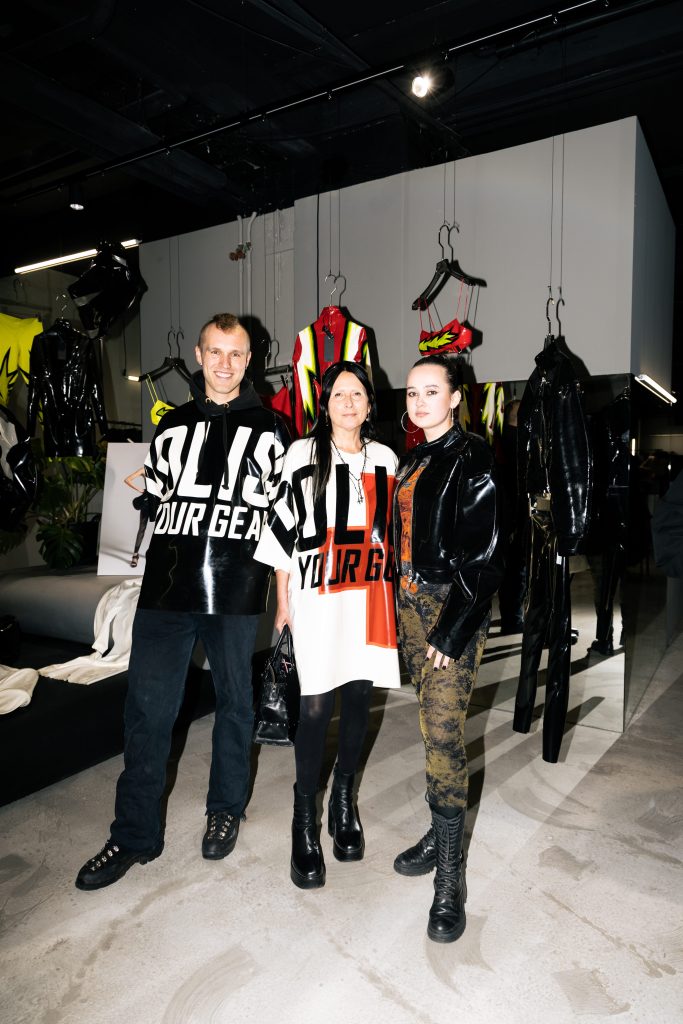
Looking ahead, what are your main goals for the coming year? Are there particular milestones you’d like to achieve, or projects you’re already working towards?
Karolina: “We definitely want to participate in Amsterdam Fashion Week again and present a show next year. We’ve also started a business programme that will continue throughout the year. We’re learning a lot from it and starting to understand which steps we need to take to develop the business into what we ultimately want it to become. For now, most of our focus will be on producing a new ready-to-wear collection and preparing a show for September.”
I’m especially curious to see what you come up with for the show. Do you already have an idea of what it might look like?
Karolina: “We don’t know yet, and it’s quite scary! But we have a few ideas and some starting points. They’re really just starting points at the moment, though. We want Suki to become more than just the concept behind one collection. We’d like her to become part of the brand’s identity, almost like an ongoing character. Through each new collection, we’d like to explore what the next chapter of her story might look like.”
Cover image by Alex Conu