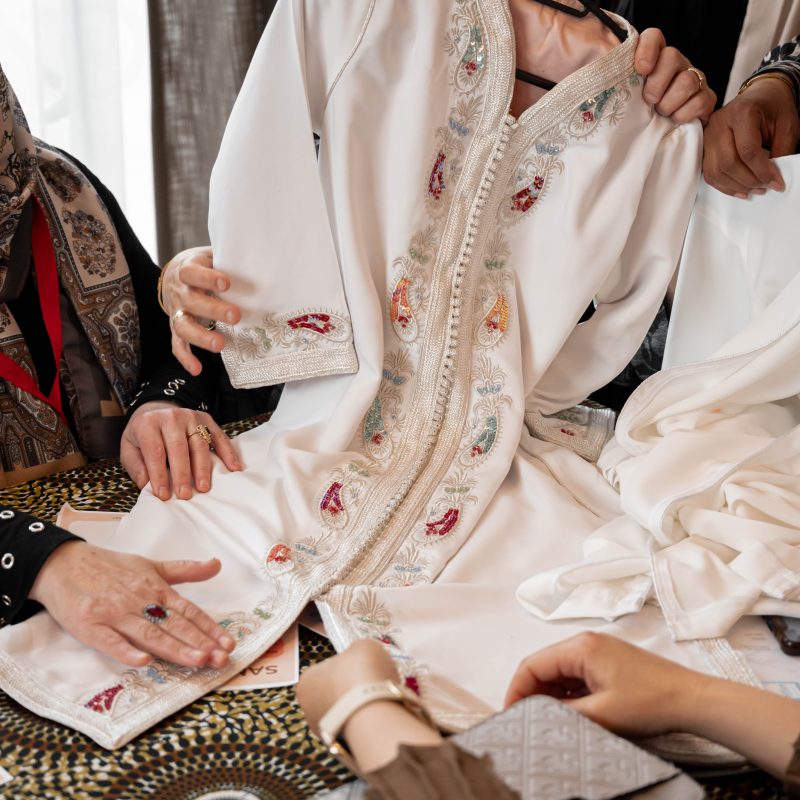
Textile Collective (Nieuw) West is putting Amsterdam’s local textile talent on the map, connecting makers, designers and organisations across West and Nieuw-West. With a focus on fair opportunities, repair, reuse and local production, the initiative is working towards a more connected and circular textile ecosystem. We speak to the collective about the craftsmanship already present in the city, and their vision for its future.
For readers who may not know Textile Collective (Nieuw) West yet, could you tell us about the organisation and the mission behind your local textile network?
Textile Collective (Nieuw) West is a local network connecting textile makers, ateliers, designers, cultural and social organisations, businesses and educational partners across Amsterdam West and Nieuw-West.
Our mission is to make local textile craftsmanship more visible and create professional and fairly paid opportunities for makers. At the same time, we want to preserve textile knowledge and strengthen a local ecosystem around repair, reuse, upcycling and small-scale production.
For us, sustainability is not only ecological, but also social and economic. We want to reduce textile waste while ensuring that the people behind the craft are recognised, valued and able to earn from their skills.
What inspired the initiative, and what kinds of talent have you discovered within the local community?
The origins of the network go back to Textiel & Talent, an empowerment programme developed and initiated by Mina Ouaouirst in Nieuw-West. Through the programme, she saw first-hand how much textile knowledge, creativity and craftsmanship was already present among women in the neighbourhood. The talent was there; what was often missing were the professional networks, business skills and confidence needed to turn those skills into paid opportunities.
This experience inspired Mina to initiate Voor de Draad together with Vrouw en Vaart and Daniella Sachs, an exploratory research project mapping the textile ecosystem of Nieuw-West, including informal makers, ateliers, entrepreneurs and organisations and the connections between them. The project later expanded to Amsterdam West through Amsterdam Dealmakers, where Zinzi Stasse joined. Together, Mina and Zinzi continued developing the network. With support from Amsterdam Dealmakers and the City of Amsterdam’s West District (Stadsdeel West), Mina and Zinzi have continued developing the network across West and Nieuw-West.
Many of the women we meet have been sewing, repairing, altering, embroidering or working with textiles for years. Some have professional experience from their countries of origin, while others learned from mothers or grandmothers. This means that some of the knowledge within the network has been passed down through generations.
What matters to us is that these women are not defined by the barriers they may face. They bring craftsmanship, techniques, cultural knowledge and perspectives that have real value.
Repair and local production are key pillars of your work. How do you hope your network can contribute to a more circular fashion industry in Amsterdam?
Our network aims to play an active role in Amsterdam’s ambition to become 70% circular by 2030. We contribute by strengthening repair, reuse, upcycling and local production in West and Nieuw-West. We also want to help create a new norm in which repairing, altering and making clothes is accessible, affordable and close to home.
By enabling small brands and designers to produce locally, we can shorten supply chains and reduce the impact of long-distance production and transport. Our network can also provide local repair and production capacity in response to Extended Producer Responsibility (EPR/UPV), helping brands keep textiles in circulation at a higher value for longer.
We are already seeing this in practice. Several makers from our network upcycled trousers for Buurtkringloop Oost, giving existing textiles a new life. Another maker produced pieces for Jonathan Ho’s new collection and contributed ideas to the design process. This shows that makers can contribute not only production capacity, but also technical knowledge and creativity.
Our approach is inspired by the Donut Economy, which connects ecological boundaries with a strong social foundation. For us, a circular textile industry is therefore not only about reducing waste, but also about meaningful work, fair income and better conditions for the people behind the products.
Beyond creating employment opportunities, what impact do you hope the network can have on makers and on the wider community?
On a personal level, many women experience the community and local ateliers as a safe space where they can recharge alongside caregiving responsibilities or social isolation. Working with their hands can build confidence and create a sense of purpose.
Professionally, makers can develop through a skills passport or vocational (MBO) certificates and gain experience working according to professional standards and the technical requirements of brands. This can create a pathway from sewing at home or as a hobby to becoming a professional maker.
Another important impact is the exchange between people who might not otherwise meet. Local makers work alongside designers, fashion professionals, cultural organisations and businesses. Makers gain access to new networks and perspectives, while other professionals encounter techniques, cultural knowledge and ways of working they may not have encountered before.
Looking ahead, one of our main ambitions is to establish a textile cooperative. This would provide a professional structure through which makers can take on commissions, receive fair compensation and become co-owners with a democratic voice in rates, working hours and working conditions.
In the future, we would love to see locally developed collections, larger repair and upcycling projects, circular workwear and more projects where makers are involved from the beginning of the creative process.
How do you see initiatives like yours contributing to Amsterdam’s fashion future?
Amsterdam already has many of the ingredients needed for a more local, social and circular fashion industry. Our vision is a city where designers naturally consider the skills, makers and materials available locally before looking elsewhere for production.
We also believe sewing, repairing and upcycling should be accessible to everyone, especially people with smaller budgets. Repairing a garment or learning how to make something yourself should not be a luxury, but something available within your own neighbourhood.
This contributes to Community Wealth Building: when Amsterdam-based designers and businesses work locally, economic value remains within the city. At the same time, knowledge, skills and professional relationships can continue to develop within local communities.
Ultimately, we hope Amsterdam can demonstrate what a different fashion system looks like in practice: one where craftsmanship is valued, repair and reuse are commonplace, and social and ecological sustainability go hand in hand.